
Academic
How to match the spectrum of DFT hydroponic system? Yecai Hero Technology: Scientific Light Formula,
作者: 时间: 2026-08-30
In DFT (deep flow) hydroponic system, nutrient solution provides water and nutrients for crops, solving the problem of "satiety"; And light is the energy source for crop photosynthesis, determining how strong they can grow after eating well. If nutrient solution is the "blood" of DFT system, then light is the "energy engine" of DFT system.
However, many DFT hydroponic growers often focus their attention on "hardware" such as nutrient solution formulations, water circulation systems, and greenhouse environments, while ignoring the core factor of spectroscopy that directly affects photosynthetic yield.
Although natural light is "free", there are natural shortcomings in greenhouse environments such as uncontrollable spectra, large seasonal variations, and insufficient light intensity in the lower layers of multi-layered planting. Artificial supplementary lighting, especially LED plant supplementary lighting, can accurately adjust the light quality ratio of different wavelengths such as red light, blue light, green light, far red light, UV, etc. according to the photosynthetic needs of crops, achieving "on-demand light supply".
A scientific spectral formula can shorten the growth cycle of lettuce by 3-5 days, increase the vitamin C content of spinach by 20%, and make the ice crystal particles of frozen vegetables more plump and attractive.
As a member unit of the Facility Agriculture Association with 16 independent intellectual property rights and three major product lines of DFT/NFT/plant factories, LEAFYMAN Technology has accumulated rich technical data and practical experience in plant spectroscopy research and LED fill light application. Today, we will start from plant photobiology and systematically dismantle the spectral configuration technology of DFT hydroponic system for you.
1、 Why does DFT hydroponic system need to focus on spectra?
The "uncontrollability" of natural light is the root cause of yield fluctuations
Seasonal changes: The natural light intensity in winter is only 30% -50% of that in summer, resulting in insufficient photosynthesis and a significant decrease in yield.
Rainy weather: Continuous cloudy weather leads to severe lack of sunlight, thinning of leaves, and growth stagnation.
Greenhouse obstruction: Greenhouse covering materials (glass, PC board, film) absorb and reflect a portion of light, with a light transmittance typically between 75% and 90%.
2. "Light blind spots" in multi-layer three-dimensional planting
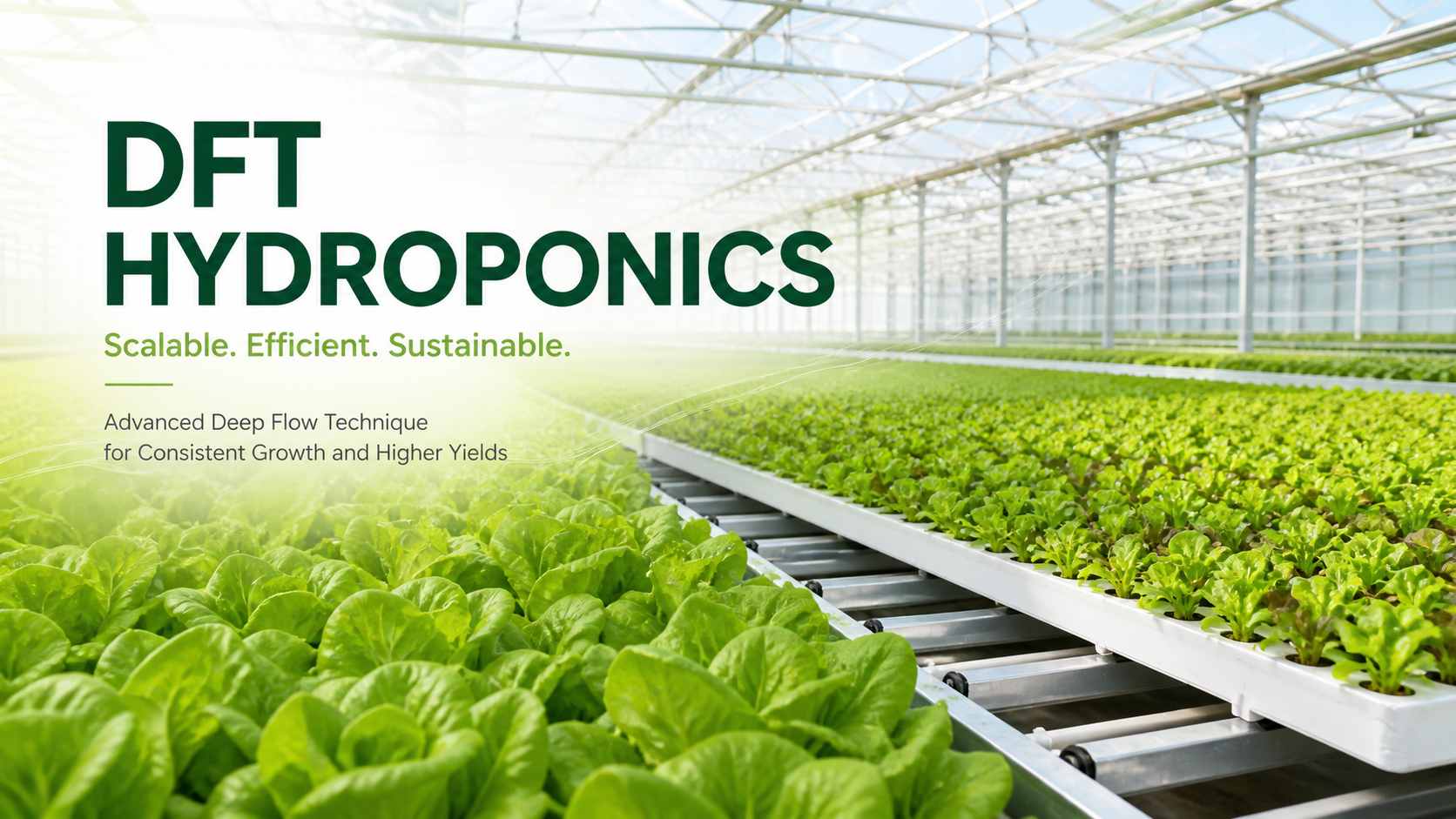
DFT hydroponic systems often use multi-layer three-dimensional cultivation racks. The upper crops block a large amount of natural light, and the lower crops often receive less than 30% of the light intensity of the upper layers, resulting in a sharp decline in yield and quality of the lower layers.
3. Spectrum directly affects the nutritional quality of crops
Different wavelengths of light not only affect the photosynthetic rate, but also regulate the secondary metabolism of plants:
Blue light: promotes the accumulation of antioxidant substances such as vitamin C, anthocyanins, flavonoids, etc.
Ultraviolet light (UV-A): increases polyphenol content, enhances disease resistance and nutritional value.
Red light: promotes the accumulation of carbohydrates (sugars) and affects the taste and sweetness.
Conclusion: In the DFT hydroponic system, by configuring scientific spectral formulas, not only can natural light deficiencies be compensated for, but crop yield, quality, and nutritional value can also be improved in a targeted manner, which is a key technical means to achieve "high yield and high quality".
2、 Spectral 'Code' of Plant Photosynthesis: The Role of Different Wavelength of Light
1. photosynthetically active radiation (PAR) range
Plant photosynthesis mainly utilizes light with a wavelength of 400-700nm, which is called photosynthetically active radiation (PAR). But different wavelengths of light have vastly different effects on plant growth.
2. Detailed explanation of core spectral bands
The main role of color in plants within the wavelength range of spectral bands
UV-A 315-400nm UV promotes secondary metabolism, increases anthocyanin and polyphenol content, enhances stress resistance and nutritional value
Blue light at 400-500nm promotes chlorophyll synthesis, stomatal opening, and leaf thickening; Inhibit excessive growth and make plants compact and robust
Green light with a wavelength of 500-600nm has strong penetration and can reach the interior of the canopy and lower leaves, improving overall photosynthetic efficiency
Red light 600-700nm red light cooperation uses core wavelengths to promote leaf extension, stem elongation, and biomass accumulation
Far red light 700-780nm regulates light morphogenesis, promotes leaf extension, and regulates flowering and plant morphology
3. The comprehensive effect of spectral ratio on DFT hydroponic leafy vegetables
The influence of spectral formula on leafy vegetables
High red light (over 70%) has a fast growth rate and a large leaf area, but the plant may be excessively long and the leaves may be thin
High blue light (over 30%) plants are compact, with thick leaves and a dark green color, but the growth rate may be slightly slower
Red blue balance (red 60% -70%+blue 20% -30%) has the best growth rate and quality balance, making it a universal formula for leafy vegetable growth
Adding green light (5% -10%) improves the illumination of the lower layer, enhances overall photosynthetic efficiency, and results in natural leaf color
Add far red light (3% -5%) to promote leaf extension, increase leaf area, and improve yield
Adding UV-A (trace) significantly increases the content of vitamin C and anthocyanins, and enhances disease resistance
3、 Comparison and Selection of Light Source Types for DFT Hydroponic Systems
Light source type, spectrum customization, energy efficiency (μ mol/J), lifespan, heat generation cost, applicable scenarios
LED plant light ★★★★★ (can be precisely adjusted) ≥ 3.0 50000h+low, medium and high preferred, suitable for all DFT scenarios
Fluorescent lamp ★★ (spectral fixation) 1.0-1.5 10000h medium and small-scale seedling cultivation
High pressure sodium lamp (HPS) ★ (reddish orange) 1.5-1.8 12000h extreme high, medium and large greenhouse top light supplement
Metal halide lamp ★★ (blue-green) 1.2-1.6 8000h high school seedling room
Conclusion of Ye Caixia Technology: LED plant lights are the absolute preferred light source for DFT hydroponic systems, as only LEDs can achieve precise spectral customization, high energy efficiency, and low heat generation, meeting the precise requirements of different crops and growth stages for light quality.
However, many DFT hydroponic growers often focus their attention on "hardware" such as nutrient solution formulations, water circulation systems, and greenhouse environments, while ignoring the core factor of spectroscopy that directly affects photosynthetic yield.
Although natural light is "free", there are natural shortcomings in greenhouse environments such as uncontrollable spectra, large seasonal variations, and insufficient light intensity in the lower layers of multi-layered planting. Artificial supplementary lighting, especially LED plant supplementary lighting, can accurately adjust the light quality ratio of different wavelengths such as red light, blue light, green light, far red light, UV, etc. according to the photosynthetic needs of crops, achieving "on-demand light supply".
A scientific spectral formula can shorten the growth cycle of lettuce by 3-5 days, increase the vitamin C content of spinach by 20%, and make the ice crystal particles of frozen vegetables more plump and attractive.
As a member unit of the Facility Agriculture Association with 16 independent intellectual property rights and three major product lines of DFT/NFT/plant factories, LEAFYMAN Technology has accumulated rich technical data and practical experience in plant spectroscopy research and LED fill light application. Today, we will start from plant photobiology and systematically dismantle the spectral configuration technology of DFT hydroponic system for you.
1、 Why does DFT hydroponic system need to focus on spectra?
The "uncontrollability" of natural light is the root cause of yield fluctuations
Seasonal changes: The natural light intensity in winter is only 30% -50% of that in summer, resulting in insufficient photosynthesis and a significant decrease in yield.
Rainy weather: Continuous cloudy weather leads to severe lack of sunlight, thinning of leaves, and growth stagnation.
Greenhouse obstruction: Greenhouse covering materials (glass, PC board, film) absorb and reflect a portion of light, with a light transmittance typically between 75% and 90%.
2. "Light blind spots" in multi-layer three-dimensional planting
DFT hydroponic systems often use multi-layer three-dimensional cultivation racks. The upper crops block a large amount of natural light, and the lower crops often receive less than 30% of the light intensity of the upper layers, resulting in a sharp decline in yield and quality of the lower layers.
3. Spectrum directly affects the nutritional quality of crops
Different wavelengths of light not only affect the photosynthetic rate, but also regulate the secondary metabolism of plants:
Blue light: promotes the accumulation of antioxidant substances such as vitamin C, anthocyanins, flavonoids, etc.
Ultraviolet light (UV-A): increases polyphenol content, enhances disease resistance and nutritional value.
Red light: promotes the accumulation of carbohydrates (sugars) and affects the taste and sweetness.
Conclusion: In the DFT hydroponic system, by configuring scientific spectral formulas, not only can natural light deficiencies be compensated for, but crop yield, quality, and nutritional value can also be improved in a targeted manner, which is a key technical means to achieve "high yield and high quality".
2、 Spectral 'Code' of Plant Photosynthesis: The Role of Different Wavelength of Light
1. photosynthetically active radiation (PAR) range
Plant photosynthesis mainly utilizes light with a wavelength of 400-700nm, which is called photosynthetically active radiation (PAR). But different wavelengths of light have vastly different effects on plant growth.
2. Detailed explanation of core spectral bands
The main role of color in plants within the wavelength range of spectral bands
UV-A 315-400nm UV promotes secondary metabolism, increases anthocyanin and polyphenol content, enhances stress resistance and nutritional value
Blue light at 400-500nm promotes chlorophyll synthesis, stomatal opening, and leaf thickening; Inhibit excessive growth and make plants compact and robust
Green light with a wavelength of 500-600nm has strong penetration and can reach the interior of the canopy and lower leaves, improving overall photosynthetic efficiency
Red light 600-700nm red light cooperation uses core wavelengths to promote leaf extension, stem elongation, and biomass accumulation
Far red light 700-780nm regulates light morphogenesis, promotes leaf extension, and regulates flowering and plant morphology
3. The comprehensive effect of spectral ratio on DFT hydroponic leafy vegetables
The influence of spectral formula on leafy vegetables
High red light (over 70%) has a fast growth rate and a large leaf area, but the plant may be excessively long and the leaves may be thin
High blue light (over 30%) plants are compact, with thick leaves and a dark green color, but the growth rate may be slightly slower
Red blue balance (red 60% -70%+blue 20% -30%) has the best growth rate and quality balance, making it a universal formula for leafy vegetable growth
Adding green light (5% -10%) improves the illumination of the lower layer, enhances overall photosynthetic efficiency, and results in natural leaf color
Add far red light (3% -5%) to promote leaf extension, increase leaf area, and improve yield
Adding UV-A (trace) significantly increases the content of vitamin C and anthocyanins, and enhances disease resistance
3、 Comparison and Selection of Light Source Types for DFT Hydroponic Systems
Light source type, spectrum customization, energy efficiency (μ mol/J), lifespan, heat generation cost, applicable scenarios
LED plant light ★★★★★ (can be precisely adjusted) ≥ 3.0 50000h+low, medium and high preferred, suitable for all DFT scenarios
Fluorescent lamp ★★ (spectral fixation) 1.0-1.5 10000h medium and small-scale seedling cultivation
High pressure sodium lamp (HPS) ★ (reddish orange) 1.5-1.8 12000h extreme high, medium and large greenhouse top light supplement
Metal halide lamp ★★ (blue-green) 1.2-1.6 8000h high school seedling room
Conclusion of Ye Caixia Technology: LED plant lights are the absolute preferred light source for DFT hydroponic systems, as only LEDs can achieve precise spectral customization, high energy efficiency, and low heat generation, meeting the precise requirements of different crops and growth stages for light quality.