
Academic
Smart Facility Agriculture: In-Depth Analysis of the Four Core Features and Operational Mechanisms o
作者: 时间: 2026-06-30
In the technical framework of modern soilless cultivation (Hydroponics), the DWC (Deep Water Culture) hydroponic system—commonly referred to in the industry as the DFT (Deep Flow Technique) deep water floating board cultivation system—has become the cornerstone of commercial leafy green factories due to its unique structural design and outstanding operational stability.
As a governing unit of the Facility Agriculture Association under the Department of Agricultural Mechanization of China, and located in the National Agricultural Comprehensive Reform Pilot Zone, LEAFYMAN (Yecaixia Technology) has digitally upgraded the core operational characteristics of the DWC system. This upgrade relies on an R&D team composed of multiple agronomists, horticulturists, fluid engineers, and automation engineers (including Master's and Ph.D. holders). Starting from the underlying design, this article provides an in-depth breakdown of the four key characteristics of an industrial-grade DWC hydroponic system.
Characteristic I. Deep Water Layer Static Buffering Structure: Constructing a "Breakwater" for the Plant Rhizosphere Environment
Unlike the thin layer of flowing water networks found in NFT (Nutrient Film Technique) systems, the fundamental characteristic of the DWC/DFT system lies in its deep water layer structure.
High Thermal Inertia: The cultivation troughs typically maintain a nutrient solution depth of 5–10 cm or more. This massive volume of water endows the system with an exceptionally strong "thermal inertia," preventing water temperatures from fluctuating drastically alongside ambient air temperatures.
Zero Blackout Anxiety: This deep water characteristic delivers a massive commercial safety dividend. Even in the event of a sudden power outage or pump failure, the water retained within the cultivation troughs can sustain normal crop growth for several days, completely eliminating the risk of total harvest failure caused by equipment breakdowns.
Characteristic II. Floating Board Suspended Cultivation Mode: Achieving the "Golden Spatial Ratio" Between Plants and Light
The core visual and physical characteristic of the DWC system is its customized planting floating boards.
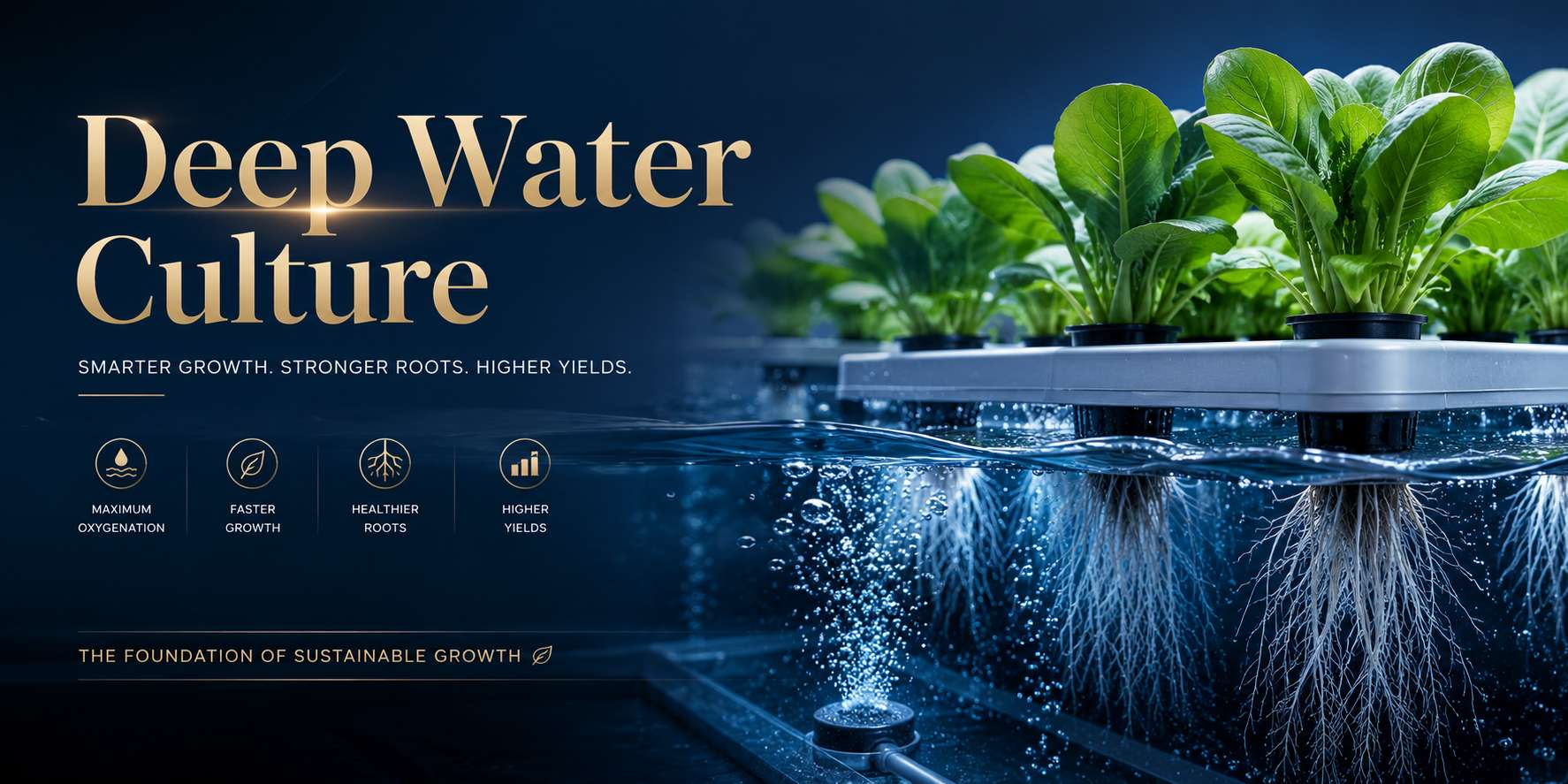
Full Life-Cycle Support: Plants are set into specialized high-density floating boards (such as polystyrene), with their root systems completely submerged in the underlying nutrient solution, while the leaves and stems remain exposed to the light and air above the boards.
Seamless Full-Automation Integration: LEAFYMAN has utilized this characteristic to optimize mechanized leafy green production scenarios. Floating boards experience minimal frictional resistance on the water surface, making them ideal for integration with automated board-pushing systems to achieve a fully mechanized workflow across sowing, thinning, and harvesting.
Characteristic III. High Dissolved Oxygen & Fluid Circulation Mechanism: Cracking the "Life Code" of Deep Water Hypoxia
Traditional deep water cultivation easily leads to water hypoxia, which triggers root rot. In contrast, industrial-grade DWC systems exhibit the distinct physical characteristics of high dissolved oxygen and powerful circulation.
Fluid Dynamics Optimization: Through precise fluid engineering design, LEAFYMAN’s core team has established 4 self-developed production techniques. By employing intermittent circulation, Venturi jets, or micro-bubble generation devices, the dissolved oxygen level within large-scale cultivation troughs is consistently maintained at a critical high threshold.
Accelerated Crop Growth: This high dissolved oxygen characteristic ensures that the root systems of leafy greens breathe highly efficiently while continuously absorbing water and fertilizer. Combined with self-developed light spectrum formulas, the overall growth cycle of leafy greens can be shortened by over 40%.
Characteristic IV. Closed-Loop Water & Fertilizer Eco-Recirculation: A Data-Driven "Green and Low-Carbon" Network
The operational characteristic of the DWC system is its highly closed-loop and precisely controllable nature.
Ultimate Resource Utilization: The nutrient solution undergoes fully enclosed operations along the route of "cultivation trough $\rightarrow$ return drainage channel $\rightarrow$ smart environmental control center $\rightarrow$ precise re-dosing $\rightarrow$ return to cultivation trough." There is zero water loss through evaporation and no surplus fertilizer infiltration. Data demonstrates that this characteristic achieves a 95% water-saving rate compared to traditional agriculture, while increasing fertilizer utilization by over 60%.
A Barrier of 16 Intellectual Property Rights: Developed around these closed-loop circulation characteristics, LEAFYMAN has secured 16 independent intellectual property rights and 3 published research papers. This allows water and fertilizer management (EC/pH/temperature/humidity) to be entirely driven by data algorithms, ensuring the harvested leafy greens reach the pristine standard of "zero pesticide residues and ready-to-eat without washing."
As a governing unit of the Facility Agriculture Association under the Department of Agricultural Mechanization of China, and located in the National Agricultural Comprehensive Reform Pilot Zone, LEAFYMAN (Yecaixia Technology) has digitally upgraded the core operational characteristics of the DWC system. This upgrade relies on an R&D team composed of multiple agronomists, horticulturists, fluid engineers, and automation engineers (including Master's and Ph.D. holders). Starting from the underlying design, this article provides an in-depth breakdown of the four key characteristics of an industrial-grade DWC hydroponic system.
Characteristic I. Deep Water Layer Static Buffering Structure: Constructing a "Breakwater" for the Plant Rhizosphere Environment
Unlike the thin layer of flowing water networks found in NFT (Nutrient Film Technique) systems, the fundamental characteristic of the DWC/DFT system lies in its deep water layer structure.
High Thermal Inertia: The cultivation troughs typically maintain a nutrient solution depth of 5–10 cm or more. This massive volume of water endows the system with an exceptionally strong "thermal inertia," preventing water temperatures from fluctuating drastically alongside ambient air temperatures.
Zero Blackout Anxiety: This deep water characteristic delivers a massive commercial safety dividend. Even in the event of a sudden power outage or pump failure, the water retained within the cultivation troughs can sustain normal crop growth for several days, completely eliminating the risk of total harvest failure caused by equipment breakdowns.
Characteristic II. Floating Board Suspended Cultivation Mode: Achieving the "Golden Spatial Ratio" Between Plants and Light
The core visual and physical characteristic of the DWC system is its customized planting floating boards.
Full Life-Cycle Support: Plants are set into specialized high-density floating boards (such as polystyrene), with their root systems completely submerged in the underlying nutrient solution, while the leaves and stems remain exposed to the light and air above the boards.
Seamless Full-Automation Integration: LEAFYMAN has utilized this characteristic to optimize mechanized leafy green production scenarios. Floating boards experience minimal frictional resistance on the water surface, making them ideal for integration with automated board-pushing systems to achieve a fully mechanized workflow across sowing, thinning, and harvesting.
Characteristic III. High Dissolved Oxygen & Fluid Circulation Mechanism: Cracking the "Life Code" of Deep Water Hypoxia
Traditional deep water cultivation easily leads to water hypoxia, which triggers root rot. In contrast, industrial-grade DWC systems exhibit the distinct physical characteristics of high dissolved oxygen and powerful circulation.
Fluid Dynamics Optimization: Through precise fluid engineering design, LEAFYMAN’s core team has established 4 self-developed production techniques. By employing intermittent circulation, Venturi jets, or micro-bubble generation devices, the dissolved oxygen level within large-scale cultivation troughs is consistently maintained at a critical high threshold.
Accelerated Crop Growth: This high dissolved oxygen characteristic ensures that the root systems of leafy greens breathe highly efficiently while continuously absorbing water and fertilizer. Combined with self-developed light spectrum formulas, the overall growth cycle of leafy greens can be shortened by over 40%.
Characteristic IV. Closed-Loop Water & Fertilizer Eco-Recirculation: A Data-Driven "Green and Low-Carbon" Network
The operational characteristic of the DWC system is its highly closed-loop and precisely controllable nature.
Ultimate Resource Utilization: The nutrient solution undergoes fully enclosed operations along the route of "cultivation trough $\rightarrow$ return drainage channel $\rightarrow$ smart environmental control center $\rightarrow$ precise re-dosing $\rightarrow$ return to cultivation trough." There is zero water loss through evaporation and no surplus fertilizer infiltration. Data demonstrates that this characteristic achieves a 95% water-saving rate compared to traditional agriculture, while increasing fertilizer utilization by over 60%.
A Barrier of 16 Intellectual Property Rights: Developed around these closed-loop circulation characteristics, LEAFYMAN has secured 16 independent intellectual property rights and 3 published research papers. This allows water and fertilizer management (EC/pH/temperature/humidity) to be entirely driven by data algorithms, ensuring the harvested leafy greens reach the pristine standard of "zero pesticide residues and ready-to-eat without washing."