
Academic
The Three Technical Cores of Deep Water Culture (DFT): The Underlying Logic of Building an Industria
作者: 时间: 2026-07-05
The Engineering Anatomy of Deep Water Culture (Floating Raft Systems): A Technical Blueprint for Industrial-Scale Smart Controlled Environment Agriculture (CEA)
In the complete puzzle of modern smart protected agriculture, the Deep Water Culture (Floating Raft System, abbreviated as DFT) is by no means merely a primitive model of "foam boards floating on water." As a highly integrated Controlled Environment Agriculture (CEA) framework, the Deep Water Culture system is hailed as the "industrial ballast" of factory-scale leafy green cultivation. This reputation is backed by a rigorous nexus of core engineering and plant physiology technologies. Only by deeply dissecting its three technical pillars—nutrient kinetics dynamic equilibrium, multi-dimensional dissolved oxygen, and flexible fully automated logistics—can one clearly understand how modern smart plant factories leverage algorithms and engineering to achieve an uninterrupted, high-yield, closed-loop production cycle year-round.
I. Core Pillar I: Nutrient Kinetics & Digital Twin Ion Dynamic Regeneration
Traditional protected agriculture often suffers from cyclical fluctuations in crop yield due to an inability to precisely manage the compositional depletion of nutrient solutions. The primary technical core of the Deep Water Culture system is the establishment of a high-precision regulation network for micro-element kinetics.
Multi-Channel Online Ion-Selective Electrode (ISE) Monitoring: Modern deep water flow systems embed a cluster of high-precision sensors tracking Electrical Conductivity (EC), pH, liquid temperature, and individual nutrient ions. This hardware network captures the consumption rates of macro-elements (nitrogen, phosphorus, potassium) as well as secondary and micro-elements (calcium, magnesium, sulfur, etc.) in real time.
Dynamic Nutrient Balance Driven by Digital Twin Algorithms: The high-frequency data harvested by sensors is uploaded directly to a cloud-based Digital Twin Irrigation Brain. The algorithmic model then executes predictive calculations by synthesizing cumulative solar radiation inside the greenhouse, real-time air humidity, and the current crop canopy growth curve. Moving away from rigid, static formulas, the system utilizes Edge Computing to dynamically adjust the millisecond-level pulse ratios of each fertilizer injection. This logic of "one strategy per plant, dynamic error correction" not only boosts water and fertilizer efficiency by over 95%, but also guarantees standardized outputs in leaf color, canopy size, and nutritional profile.
II. Core Pillar II: Venturi Turbulent Micro-Circulation & Multi-Dimensional Micro-Bubble Aeration
Because deep water flow cultivation involves massive water volumes (with liquid depths typically ranging from 10 to 30 cm), breaking liquid laminar flow and eliminating localized stagnant water and hypoxia constitutes its most fundamental engineering challenge.
Venturi Aeration & Turbulence Engineering: Utilizing Computational Fluid Dynamics (CFD) simulations, modern DFT systems deploy a three-dimensional drainage and jet injection network across the culture tank floors. The system forces micro-bubbles into the circulating nutrient solution via Venturi nozzles, disrupting static laminar flow at the bottom of the tank and converting it into a uniformly flowing Turbulent Micro-Circulation.
Dual Root System Absorption Mechanism (Aerial & Aquatic Roots): By precisely controlling a 1–2 cm air gap intentionally reserved between the floating rafts and the water surface, the system stimulates the crop roots to develop an abundance of specialized, respiration-focused Aerial Roots in the air, while developing specialized Aquatic Roots beneath the liquid level to absorb water and fertilizer. Working in tandem with a dissolved oxygen (DO) environment stably maintained at a high 6.5–8.0 mg/L, this dual absorption mechanism completely eradicates the root-rot curse of deep-water cultivation, accelerating crop physiological metabolism by more than 20%.
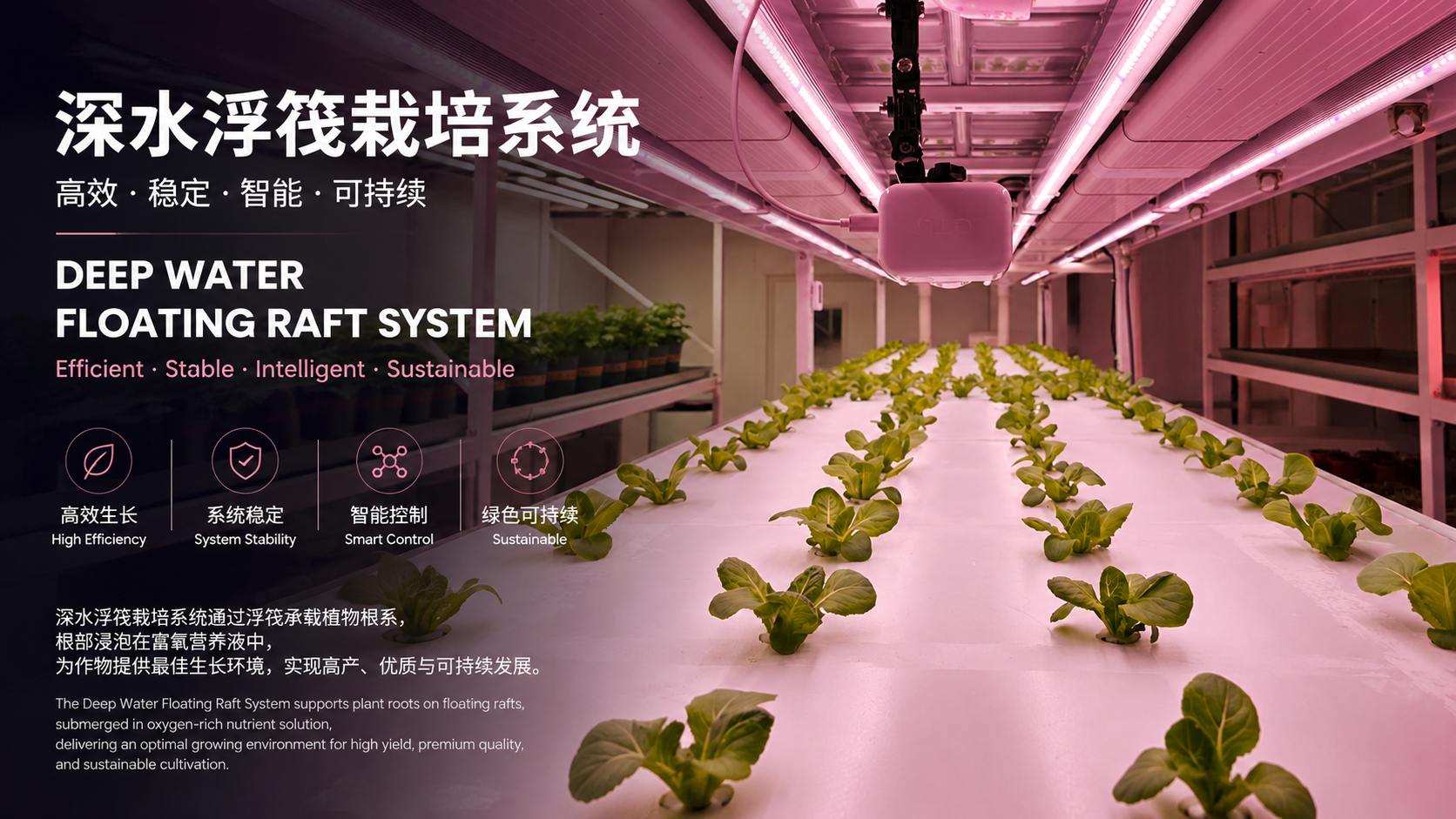
III. Core Pillar III: Flexible Water-Surface Logistics & Unmanned Life-Cycle Automation
The third core pillar of the Deep Water Culture system lies in its ideal physical architecture, which easily cross-couples with modern industrial logistics (Intralogistics) to unlock the ultimate limits of space efficiency.
Aisle-Free "Waterborne AGV" Logistics Network: Exploiting the low-friction physical trait of cultivation boards floating directly on the water, the DFT system can seamlessly integrate modular water-surface gliding logistics technology. The process flows smoothly from the terminal—where automated robotic arms handle seeding and germination acceleration—to autonomous gliding entry at the start of the culture tanks, and finally to the tail end where hydraulic or motorized mechanisms propel the entire raft into a centralized harvesting and washing line upon crop maturity.
Variable Mechanical Spacing Approaching Physical Spatial Limits: Coupled with Radio Frequency Identification (RFID) and intelligent variable-spacing linkage technology, the cultivation boards can automatically adjust their arrangement density on the water according to the crop growth cycle (tightly packed during the seedling stage and automatically spread apart as the canopy matures). This flexible automated equipment entirely eliminates the 30%+ fixed operational aisle waste characteristic of traditional agriculture. By pushing the space utilization of the internal greenhouse planting area straight to its physical limit of 90% to 95%, it establishes a fully automated, unmanned industrial paradigm across the entire crop life cycle.
In the complete puzzle of modern smart protected agriculture, the Deep Water Culture (Floating Raft System, abbreviated as DFT) is by no means merely a primitive model of "foam boards floating on water." As a highly integrated Controlled Environment Agriculture (CEA) framework, the Deep Water Culture system is hailed as the "industrial ballast" of factory-scale leafy green cultivation. This reputation is backed by a rigorous nexus of core engineering and plant physiology technologies. Only by deeply dissecting its three technical pillars—nutrient kinetics dynamic equilibrium, multi-dimensional dissolved oxygen, and flexible fully automated logistics—can one clearly understand how modern smart plant factories leverage algorithms and engineering to achieve an uninterrupted, high-yield, closed-loop production cycle year-round.
I. Core Pillar I: Nutrient Kinetics & Digital Twin Ion Dynamic Regeneration
Traditional protected agriculture often suffers from cyclical fluctuations in crop yield due to an inability to precisely manage the compositional depletion of nutrient solutions. The primary technical core of the Deep Water Culture system is the establishment of a high-precision regulation network for micro-element kinetics.
Multi-Channel Online Ion-Selective Electrode (ISE) Monitoring: Modern deep water flow systems embed a cluster of high-precision sensors tracking Electrical Conductivity (EC), pH, liquid temperature, and individual nutrient ions. This hardware network captures the consumption rates of macro-elements (nitrogen, phosphorus, potassium) as well as secondary and micro-elements (calcium, magnesium, sulfur, etc.) in real time.
Dynamic Nutrient Balance Driven by Digital Twin Algorithms: The high-frequency data harvested by sensors is uploaded directly to a cloud-based Digital Twin Irrigation Brain. The algorithmic model then executes predictive calculations by synthesizing cumulative solar radiation inside the greenhouse, real-time air humidity, and the current crop canopy growth curve. Moving away from rigid, static formulas, the system utilizes Edge Computing to dynamically adjust the millisecond-level pulse ratios of each fertilizer injection. This logic of "one strategy per plant, dynamic error correction" not only boosts water and fertilizer efficiency by over 95%, but also guarantees standardized outputs in leaf color, canopy size, and nutritional profile.
II. Core Pillar II: Venturi Turbulent Micro-Circulation & Multi-Dimensional Micro-Bubble Aeration
Because deep water flow cultivation involves massive water volumes (with liquid depths typically ranging from 10 to 30 cm), breaking liquid laminar flow and eliminating localized stagnant water and hypoxia constitutes its most fundamental engineering challenge.
Venturi Aeration & Turbulence Engineering: Utilizing Computational Fluid Dynamics (CFD) simulations, modern DFT systems deploy a three-dimensional drainage and jet injection network across the culture tank floors. The system forces micro-bubbles into the circulating nutrient solution via Venturi nozzles, disrupting static laminar flow at the bottom of the tank and converting it into a uniformly flowing Turbulent Micro-Circulation.
Dual Root System Absorption Mechanism (Aerial & Aquatic Roots): By precisely controlling a 1–2 cm air gap intentionally reserved between the floating rafts and the water surface, the system stimulates the crop roots to develop an abundance of specialized, respiration-focused Aerial Roots in the air, while developing specialized Aquatic Roots beneath the liquid level to absorb water and fertilizer. Working in tandem with a dissolved oxygen (DO) environment stably maintained at a high 6.5–8.0 mg/L, this dual absorption mechanism completely eradicates the root-rot curse of deep-water cultivation, accelerating crop physiological metabolism by more than 20%.
III. Core Pillar III: Flexible Water-Surface Logistics & Unmanned Life-Cycle Automation
The third core pillar of the Deep Water Culture system lies in its ideal physical architecture, which easily cross-couples with modern industrial logistics (Intralogistics) to unlock the ultimate limits of space efficiency.
Aisle-Free "Waterborne AGV" Logistics Network: Exploiting the low-friction physical trait of cultivation boards floating directly on the water, the DFT system can seamlessly integrate modular water-surface gliding logistics technology. The process flows smoothly from the terminal—where automated robotic arms handle seeding and germination acceleration—to autonomous gliding entry at the start of the culture tanks, and finally to the tail end where hydraulic or motorized mechanisms propel the entire raft into a centralized harvesting and washing line upon crop maturity.
Variable Mechanical Spacing Approaching Physical Spatial Limits: Coupled with Radio Frequency Identification (RFID) and intelligent variable-spacing linkage technology, the cultivation boards can automatically adjust their arrangement density on the water according to the crop growth cycle (tightly packed during the seedling stage and automatically spread apart as the canopy matures). This flexible automated equipment entirely eliminates the 30%+ fixed operational aisle waste characteristic of traditional agriculture. By pushing the space utilization of the internal greenhouse planting area straight to its physical limit of 90% to 95%, it establishes a fully automated, unmanned industrial paradigm across the entire crop life cycle.