
Academic
Confronting the Four Major Technological Drawbacks of Deep Water Culture: LEAFYMAN’s Disruptive, Ind
作者: 时间: 2026-07-06
Overcoming the Structural Flaws of Deep Water Culture: How Advanced Engineering Redefines the Floating Raft System
By virtue of its massive thermal inertia and exceptional risk-mitigation capabilities, the Deep Water Culture (Floating Raft System, abbreviated as DFT) has long served as the industrial "ballast" for the factory-scale cultivation of bulk leafy greens. However, every technology is a double-edged sword. In actual commercial operations, traditional DFT systems frequently inflict severe financial losses on investors due to underlying engineering flaws—most notably localized hypoxia driven by water stagnation, catastrophic disease outbreaks triggered by backwater dead zones, exorbitant initial fertilizer and water costs (CAPEX), and massive algae proliferation.
As a pioneering leader in modern protected agriculture, LEAFYMAN (Leafyman Technology) has refused to shy away from these universally acknowledged industry pain points. Instead, by cross-integrating fluid dynamics, polymer materials science, and edge computing, LEAFYMAN has delivered a disruptive, industrial-grade solution.
I. Flaw One: Water Stagnation and Root-Zone Localized Hypoxia
Industry Pain Point: Because the culture tanks in deep water systems hold a massive volume of water (with fluid depths frequently reaching 10–30 cm), traditional water pumps easily create "laminar flow short-circuiting." Vast volumes of nutrient solution stagnate at the bottom or along the edges of the tank, forming "dead zones." This causes localized Dissolved Oxygen (DO) levels to plummet below 3.0 mg/L, triggering severe anaerobic root rot.
The LEAFYMAN Solution (Multi-Dimensional Hydrodynamic Backwater Matrix): Utilizing Computational Fluid Dynamics (CFD) software, LEAFYMAN completely redesigned the 3D jet-injection network at the bottom of the culture tanks. By deploying Venturi micro-bubble jet technology, the system forcibly establishes a high-frequency, blind-spot-free "turbulent micro-circulation" within the tank. This locks the dissolved oxygen across the entire water body into a golden growth zone of 6.5–8.0 mg/L, eradicating root rot caused by localized hypoxia from the foundational engineering level.
II. Flaw Two: The "Waterborne Pathogen Storm" of All-Pool Contamination
Industry Pain Point: Traditional DFT systems operate on a "single-pool, shared-water" design. If even a single plant becomes infected with root rot (such as Pythium) or fusarium wilt, the pathogens rapidly proliferate throughout the entire tank and greenhouse via the water current, resulting in catastrophic, irreversible total crop failure.
The LEAFYMAN Solution (Grid-Based Independent Hydraulic Zonation & Advanced Physical Isolation Systems): LEAFYMAN has shattered the crude, traditional "one-pool-to-the-end" design by introducing flexible, modularly isolated hydraulic units. Concurrently, a high-dosage, Short-Wave Ultraviolet (UVC) + Composite Ozone secondary Advanced Oxidation Process (AOP) sterilization matrix is embedded into the backwater architecture. While guaranteeing that essential trace elements (such as chelated iron) in the nutrient solution remain undamaged, it achieves a 99.9% single-cycle kill rate of pathogens, erecting an industrial-grade biosecurity moat.
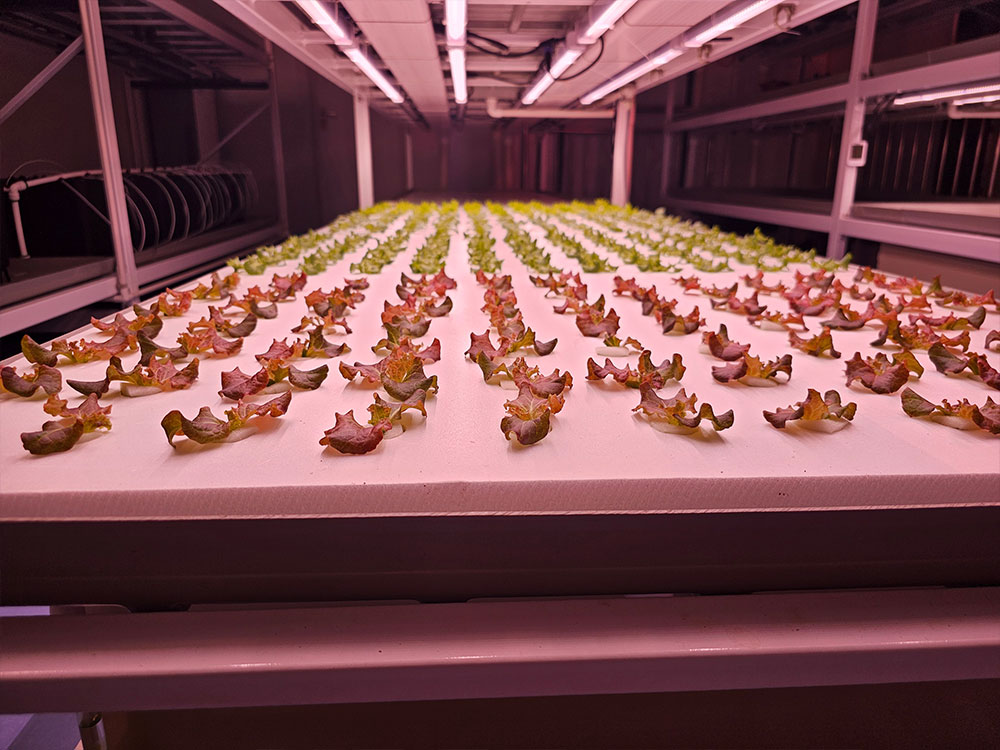
III. Flaw Three: Exorbitant Initial Water/Fertilizer Capital Expenditures and Matrix Aging
Industry Pain Point: Initially filling a deep-water cultivation tank requires an immense volume of water and highly concentrated fertilizer formulations, driving up initial Capital Expenditures (CAPEX). Furthermore, because the water is not frequently exchanged over long periods, the accumulation of root exudates and specific target ions (such as sodium and chloride) induces salinization. This causes rapid degradation of the nutrient solution formula, forcing investors to face heavy wastewater treatment costs later on.
The LEAFYMAN Solution (Digital Twin Irrigation Brain & Reverse Osmosis Dynamic Regeneration Technology): LEAFYMAN deploys a cluster of precision, online Ion-Selective Electrode (ISE) sensors. Paired with a cloud-based Digital Twin model, the system monitors the consumption rate of individual ions in real time. Operating alongside a proprietary dynamic Reverse Osmosis (RO) closed-loop recycling and regeneration algorithm, the system extracts only the accumulated toxins and excess salts. This achieves a long-term "zero-wastewater discharge cycle," boosting the life-cycle utilization rate of the initial fertilizer and water by over 95% and drastically slashing long-term Operating Expenses (OPEX).
IV. Flaw Four: Algae and Moss Explosions on Cultivation Boards and Tank Walls
Industry Pain Point: Due to abundant light and nutrient-rich water, the edges of cultivation boards and the walls of traditional DFT tanks are highly susceptible to massive outbreaks of green algae. These algae aggressively compete with crops for nutrients and oxygen, adhere to root systems to obstruct plant respiration, and demand exorbitant manual labor costs to clean and maintain.
The LEAFYMAN Solution (Novel Biodegradable, Food-Grade, Anti-Bacterial & Anti-Algae Composite Cultivation Boards): Moving away from traditional expanded polystyrene (EPS) materials that easily harbor algae, LEAFYMAN utilizes a self-developed, food-grade, anti-bacterial, and anti-UV polymer insulation composite material. Its surface features exceptional hydrophobicity and resistance to algal biofilm adhesion. Combined with a specialized, seamless, algae-inhibiting impermeable liner within the culture tank, the system reduces internal algae proliferation by over 92%, delivering a streamlined maintenance experience with virtually zero manual cleaning required.
By virtue of its massive thermal inertia and exceptional risk-mitigation capabilities, the Deep Water Culture (Floating Raft System, abbreviated as DFT) has long served as the industrial "ballast" for the factory-scale cultivation of bulk leafy greens. However, every technology is a double-edged sword. In actual commercial operations, traditional DFT systems frequently inflict severe financial losses on investors due to underlying engineering flaws—most notably localized hypoxia driven by water stagnation, catastrophic disease outbreaks triggered by backwater dead zones, exorbitant initial fertilizer and water costs (CAPEX), and massive algae proliferation.
As a pioneering leader in modern protected agriculture, LEAFYMAN (Leafyman Technology) has refused to shy away from these universally acknowledged industry pain points. Instead, by cross-integrating fluid dynamics, polymer materials science, and edge computing, LEAFYMAN has delivered a disruptive, industrial-grade solution.
I. Flaw One: Water Stagnation and Root-Zone Localized Hypoxia
Industry Pain Point: Because the culture tanks in deep water systems hold a massive volume of water (with fluid depths frequently reaching 10–30 cm), traditional water pumps easily create "laminar flow short-circuiting." Vast volumes of nutrient solution stagnate at the bottom or along the edges of the tank, forming "dead zones." This causes localized Dissolved Oxygen (DO) levels to plummet below 3.0 mg/L, triggering severe anaerobic root rot.
The LEAFYMAN Solution (Multi-Dimensional Hydrodynamic Backwater Matrix): Utilizing Computational Fluid Dynamics (CFD) software, LEAFYMAN completely redesigned the 3D jet-injection network at the bottom of the culture tanks. By deploying Venturi micro-bubble jet technology, the system forcibly establishes a high-frequency, blind-spot-free "turbulent micro-circulation" within the tank. This locks the dissolved oxygen across the entire water body into a golden growth zone of 6.5–8.0 mg/L, eradicating root rot caused by localized hypoxia from the foundational engineering level.
II. Flaw Two: The "Waterborne Pathogen Storm" of All-Pool Contamination
Industry Pain Point: Traditional DFT systems operate on a "single-pool, shared-water" design. If even a single plant becomes infected with root rot (such as Pythium) or fusarium wilt, the pathogens rapidly proliferate throughout the entire tank and greenhouse via the water current, resulting in catastrophic, irreversible total crop failure.
The LEAFYMAN Solution (Grid-Based Independent Hydraulic Zonation & Advanced Physical Isolation Systems): LEAFYMAN has shattered the crude, traditional "one-pool-to-the-end" design by introducing flexible, modularly isolated hydraulic units. Concurrently, a high-dosage, Short-Wave Ultraviolet (UVC) + Composite Ozone secondary Advanced Oxidation Process (AOP) sterilization matrix is embedded into the backwater architecture. While guaranteeing that essential trace elements (such as chelated iron) in the nutrient solution remain undamaged, it achieves a 99.9% single-cycle kill rate of pathogens, erecting an industrial-grade biosecurity moat.
III. Flaw Three: Exorbitant Initial Water/Fertilizer Capital Expenditures and Matrix Aging
Industry Pain Point: Initially filling a deep-water cultivation tank requires an immense volume of water and highly concentrated fertilizer formulations, driving up initial Capital Expenditures (CAPEX). Furthermore, because the water is not frequently exchanged over long periods, the accumulation of root exudates and specific target ions (such as sodium and chloride) induces salinization. This causes rapid degradation of the nutrient solution formula, forcing investors to face heavy wastewater treatment costs later on.
The LEAFYMAN Solution (Digital Twin Irrigation Brain & Reverse Osmosis Dynamic Regeneration Technology): LEAFYMAN deploys a cluster of precision, online Ion-Selective Electrode (ISE) sensors. Paired with a cloud-based Digital Twin model, the system monitors the consumption rate of individual ions in real time. Operating alongside a proprietary dynamic Reverse Osmosis (RO) closed-loop recycling and regeneration algorithm, the system extracts only the accumulated toxins and excess salts. This achieves a long-term "zero-wastewater discharge cycle," boosting the life-cycle utilization rate of the initial fertilizer and water by over 95% and drastically slashing long-term Operating Expenses (OPEX).
IV. Flaw Four: Algae and Moss Explosions on Cultivation Boards and Tank Walls
Industry Pain Point: Due to abundant light and nutrient-rich water, the edges of cultivation boards and the walls of traditional DFT tanks are highly susceptible to massive outbreaks of green algae. These algae aggressively compete with crops for nutrients and oxygen, adhere to root systems to obstruct plant respiration, and demand exorbitant manual labor costs to clean and maintain.
The LEAFYMAN Solution (Novel Biodegradable, Food-Grade, Anti-Bacterial & Anti-Algae Composite Cultivation Boards): Moving away from traditional expanded polystyrene (EPS) materials that easily harbor algae, LEAFYMAN utilizes a self-developed, food-grade, anti-bacterial, and anti-UV polymer insulation composite material. Its surface features exceptional hydrophobicity and resistance to algal biofilm adhesion. Combined with a specialized, seamless, algae-inhibiting impermeable liner within the culture tank, the system reduces internal algae proliferation by over 92%, delivering a streamlined maintenance experience with virtually zero manual cleaning required.