
Academic
The Future of Deep Water Culture (Floating Raft Systems): The Next Wave of Digital Revolution, Flexi
作者: 时间: 2026-07-07
The Future of Deep Water Culture (Floating Raft Systems): The Next Wave of Digital Revolution, Flexible Automation, and Low-Carbon Agriculture
As soaring global population growth drives the demand for high-quality food, and as arable land and freshwater resources continue to tighten, the transition of traditional agriculture toward factory-style, industrialized production has entered deep waters. Amidst a complex array of hydroponic technical pathways, the Deep Water Culture (Floating Raft System, abbreviated as DFT)—by virtue of its massive Thermal Inertia and unparalleled environmental robustness—is undergoing a profound technological metamorphosis. In the coming years, with the comprehensive integration of digital twins, computer vision, flexible automation, and next-generation low-carbon materials, the Floating Raft System will not merely remain relevant; it is poised to spearhead a golden explosion in the construction of intelligent, "bulk leafy green digital factories."
I. Digital Upgrading: "Unmanned Biological Workshops" Driven by Digital Twins and Edge Computing
The core technological breakthrough for future Floating Raft Systems will extend far beyond the physical construction of cultivation tanks; the true evolution lies in the "intelligent brain" operating behind them.
Computer Vision & Full-Spectrum Root Monitoring: Traditional deep-water cultivation relies heavily on manual sampling to inspect root development. Future DFT systems will seamlessly integrate computer vision spectral cameras mounted on fully automated tracking rails. This technology will not only perform millisecond-level scans of the crop canopy on the raft surface, but will also utilize sub-aquatic infrared imaging to bypass water barriers. This enables digital modeling of root development, metabolic activity, and nutrient absorption dynamics, predicting physiological deficiencies or potential diseases up to 48 hours in advance.
Edge Computing & Dynamic Adjustments to Fertilizer Formulae: Enhanced by AI-driven Edge Computing, future deep water flow systems will manage nutrient solutions with remarkable foresight. AI models can run inverse derivations to dynamically adjust Electrical Conductivity (EC), pH, and multi-dimensional Dissolved Oxygen (DO) indicators. These adjustments are based on 72-hour weather forecasts, greenhouse microclimate simulation data, and real-time crop growth curves. This marks a complete paradigm shift from a reactive "curative approach after plant issues manifest" to a proactive "algorithm-driven, precision preventive supply."
II. Evolution of Equipment Engineering: Flexible Logistics Automation and the Ultimate Liberation of Space Efficiency
Future Floating Raft Systems will transition completely toward a Flexible Automation paradigm that blends seamlessly with industrial logistics networks.
Autonomous Water-Surface Logistics (AGV-style Water Logistics): Capitalizing on the physical trait of cultivation boards floating directly on water, future rafts will feature Radio Frequency Identification (RFID) combined with intelligent magnetic or microfluidic propulsion units. Cultivation boards will no longer depend purely on mechanical pushers for linear movement; instead, they will execute flexible matrix routing dictated by algorithmic commands. At the seedling stage, rafts are tightly clustered in high density. As the crop grows and demands more space, the rafts autonomously cross tracks and expand their spacing on the water's surface. Upon maturity, the crops glide automatically toward the terminal washing line. By eliminating fixed aisles within the greenhouse, effective planting space utilization will approach the physical limit of 95%, slashing manual operational costs by over 50% beyond current automated baselines.
III. Green and Low-Carbon Transformation: Eco-Closed Loops Coupling Low-Carbon Composites with Renewable Energy
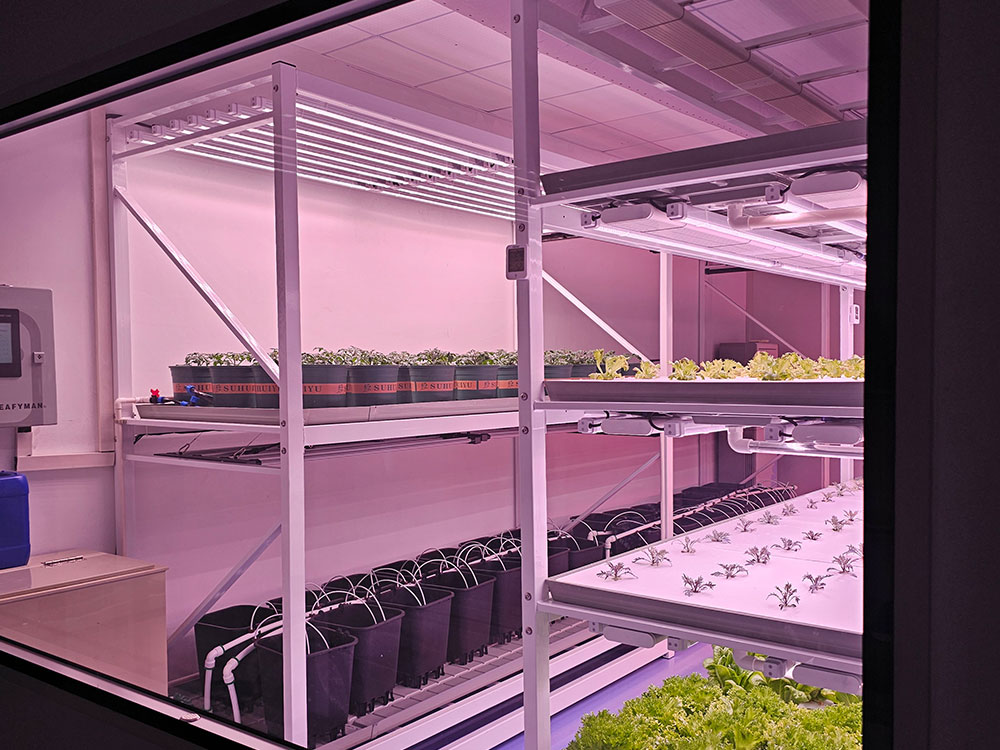
Against the macro-backdrop of global carbon reduction, the energy and material consumption profiles of future Floating Raft Systems will undergo a green restructuring.
Application of Novel Low-Carbon Composite Insulation Materials: Traditional expanded polystyrene (EPS) cultivation boards are progressively being replaced by novel, biodegradable, high-strength, food-grade bio-based composite insulation materials. These new materials boast superior anti-bacterial and anti-algae-adhesion properties, while their ultra-high thermal insulation performance reduces heat exchange losses between the water body and the external environment by over 40%.
Perfect Coupling of Renewable Energy and Aquatic Thermal Inertia: The vast water capacity of the DFT system serves as a natural energy storage reservoir. Future systems will couple deeply with rooftop Building-Integrated Photovoltaics (BIPV), shallow ground-source heat pumps, and industrial waste heat systems. Surplus solar electricity generated during the day can be used to pre-cool or pre-heat the massive water volume in the cultivation tanks, storing energy that can be released at night or during peak electricity pricing hours. This underlying logic of "aquatic thermal energy storage" will drastically slash the operating expenses (OPEX) of large-scale plant factories, ushering the industry into a low-carbon or even zero-carbon agricultural era.
As soaring global population growth drives the demand for high-quality food, and as arable land and freshwater resources continue to tighten, the transition of traditional agriculture toward factory-style, industrialized production has entered deep waters. Amidst a complex array of hydroponic technical pathways, the Deep Water Culture (Floating Raft System, abbreviated as DFT)—by virtue of its massive Thermal Inertia and unparalleled environmental robustness—is undergoing a profound technological metamorphosis. In the coming years, with the comprehensive integration of digital twins, computer vision, flexible automation, and next-generation low-carbon materials, the Floating Raft System will not merely remain relevant; it is poised to spearhead a golden explosion in the construction of intelligent, "bulk leafy green digital factories."
I. Digital Upgrading: "Unmanned Biological Workshops" Driven by Digital Twins and Edge Computing
The core technological breakthrough for future Floating Raft Systems will extend far beyond the physical construction of cultivation tanks; the true evolution lies in the "intelligent brain" operating behind them.
Computer Vision & Full-Spectrum Root Monitoring: Traditional deep-water cultivation relies heavily on manual sampling to inspect root development. Future DFT systems will seamlessly integrate computer vision spectral cameras mounted on fully automated tracking rails. This technology will not only perform millisecond-level scans of the crop canopy on the raft surface, but will also utilize sub-aquatic infrared imaging to bypass water barriers. This enables digital modeling of root development, metabolic activity, and nutrient absorption dynamics, predicting physiological deficiencies or potential diseases up to 48 hours in advance.
Edge Computing & Dynamic Adjustments to Fertilizer Formulae: Enhanced by AI-driven Edge Computing, future deep water flow systems will manage nutrient solutions with remarkable foresight. AI models can run inverse derivations to dynamically adjust Electrical Conductivity (EC), pH, and multi-dimensional Dissolved Oxygen (DO) indicators. These adjustments are based on 72-hour weather forecasts, greenhouse microclimate simulation data, and real-time crop growth curves. This marks a complete paradigm shift from a reactive "curative approach after plant issues manifest" to a proactive "algorithm-driven, precision preventive supply."
II. Evolution of Equipment Engineering: Flexible Logistics Automation and the Ultimate Liberation of Space Efficiency
Future Floating Raft Systems will transition completely toward a Flexible Automation paradigm that blends seamlessly with industrial logistics networks.
Autonomous Water-Surface Logistics (AGV-style Water Logistics): Capitalizing on the physical trait of cultivation boards floating directly on water, future rafts will feature Radio Frequency Identification (RFID) combined with intelligent magnetic or microfluidic propulsion units. Cultivation boards will no longer depend purely on mechanical pushers for linear movement; instead, they will execute flexible matrix routing dictated by algorithmic commands. At the seedling stage, rafts are tightly clustered in high density. As the crop grows and demands more space, the rafts autonomously cross tracks and expand their spacing on the water's surface. Upon maturity, the crops glide automatically toward the terminal washing line. By eliminating fixed aisles within the greenhouse, effective planting space utilization will approach the physical limit of 95%, slashing manual operational costs by over 50% beyond current automated baselines.
III. Green and Low-Carbon Transformation: Eco-Closed Loops Coupling Low-Carbon Composites with Renewable Energy
Against the macro-backdrop of global carbon reduction, the energy and material consumption profiles of future Floating Raft Systems will undergo a green restructuring.
Application of Novel Low-Carbon Composite Insulation Materials: Traditional expanded polystyrene (EPS) cultivation boards are progressively being replaced by novel, biodegradable, high-strength, food-grade bio-based composite insulation materials. These new materials boast superior anti-bacterial and anti-algae-adhesion properties, while their ultra-high thermal insulation performance reduces heat exchange losses between the water body and the external environment by over 40%.
Perfect Coupling of Renewable Energy and Aquatic Thermal Inertia: The vast water capacity of the DFT system serves as a natural energy storage reservoir. Future systems will couple deeply with rooftop Building-Integrated Photovoltaics (BIPV), shallow ground-source heat pumps, and industrial waste heat systems. Surplus solar electricity generated during the day can be used to pre-cool or pre-heat the massive water volume in the cultivation tanks, storing energy that can be released at night or during peak electricity pricing hours. This underlying logic of "aquatic thermal energy storage" will drastically slash the operating expenses (OPEX) of large-scale plant factories, ushering the industry into a low-carbon or even zero-carbon agricultural era.