
Academic
Core Strategic Advantages of DFT Hydroponic Systems
作者: 时间: 2026-05-09
Core Strategic Advantages of DFT Hydroponic Systems
Building upon the technical framework of LEAFYMAN®, the following analysis outlines the competitive advantages of the Deep Flow Technique (DFT) from an engineering and physiological perspective, tailored for global agricultural decision-makers.
1. Superior Thermodynamic Stability and Thermal Inertia
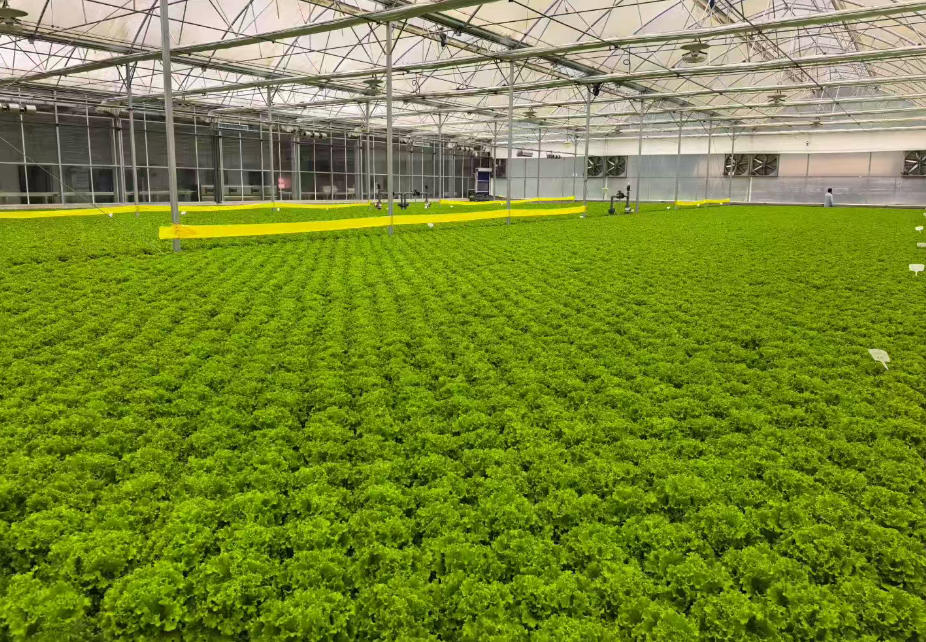
The defining characteristic of a DFT system is its significant nutrient solution volume. From a thermodynamic standpoint, this creates a robust "thermal buffer."
Root-Zone Climate Control: Water has a high specific heat capacity. The deep liquid layer (5–10cm+) acts as a heat sink, absorbing environmental temperature spikes during the day and releasing heat slowly at night.
Climatic Resilience: In regions with extreme diurnal temperature shifts, DFT maintains root temperatures within an optimal metabolic range (typically $18\text{--}24^\circ\text{C}$), preventing the physiological bolting or root senescence common in thinner-film systems during heatwaves.
2. High Operational Redundancy and Risk Mitigation
For modern facilities, especially those operating under the single-operator model, DFT serves as a critical safety insurance policy.
Anti-Failure Buffer: In the event of a mechanical pump failure or a localized power outage, the stagnant nutrient reservoir in the troughs provides a life-support system for the plants. Crops can typically survive for 24 to 48 hours without active circulation.
Error Tolerance: This "buffer time" allows technicians to address hardware issues without the immediate threat of total crop loss, a luxury not afforded by systems that rely on continuous film flow (like NFT).
3. Uniform Nutrient Distribution and Crop Consistency
DFT systems leverage macro-fluid dynamics to ensure that every plant in a commercial-scale facility receives identical inputs.
Gradient Elimination: In long-channel cultivation, nutrient depletion can occur from the inlet to the outlet. DFT’s deep reservoir, combined with LEAFYMAN’s intermittent circulation logic, homogenizes EC (Electrical Conductivity) and pH levels across the entire trough.
Harvest Uniformity: Consistent nutrient availability results in high "crop parity," ensuring that the entire batch reaches market weight simultaneously—a vital metric for industrial supply chains and automated packaging.
4. Structural Synergy with Industrial Automation
As global agriculture shifts toward "Leafy Green Mechanization," the physical architecture of DFT offers distinct advantages for integration.
Planar Precision: The level, stable water surface provides a perfect horizontal datum. This makes it significantly easier to deploy automated transplanting robots and mechanical harvesters that operate on gantry or rail systems.
Reduced Maintenance Overhead: Because the system operates at lower pressures and higher volumes, it is less prone to "salt crusting" or biofilm blockages in the piping, which significantly reduces the man-hours required for system cleaning between growth cycles.
Expert Perspective by LEAFYMAN®
While the initial water and nutrient loading for a DFT system is higher than that of thin-film alternatives, the Return on Investment (ROI) is realized through drastic reductions in crop loss risks and labor intensity. By integrating our 16 proprietary intellectual properties, LEAFYMAN® has evolved the traditional DFT model into a high-precision production engine that bridges the gap between biological potential and industrial efficiency.
Building upon the technical framework of LEAFYMAN®, the following analysis outlines the competitive advantages of the Deep Flow Technique (DFT) from an engineering and physiological perspective, tailored for global agricultural decision-makers.
1. Superior Thermodynamic Stability and Thermal Inertia
The defining characteristic of a DFT system is its significant nutrient solution volume. From a thermodynamic standpoint, this creates a robust "thermal buffer."
Root-Zone Climate Control: Water has a high specific heat capacity. The deep liquid layer (5–10cm+) acts as a heat sink, absorbing environmental temperature spikes during the day and releasing heat slowly at night.
Climatic Resilience: In regions with extreme diurnal temperature shifts, DFT maintains root temperatures within an optimal metabolic range (typically $18\text{--}24^\circ\text{C}$), preventing the physiological bolting or root senescence common in thinner-film systems during heatwaves.
2. High Operational Redundancy and Risk Mitigation
For modern facilities, especially those operating under the single-operator model, DFT serves as a critical safety insurance policy.
Anti-Failure Buffer: In the event of a mechanical pump failure or a localized power outage, the stagnant nutrient reservoir in the troughs provides a life-support system for the plants. Crops can typically survive for 24 to 48 hours without active circulation.
Error Tolerance: This "buffer time" allows technicians to address hardware issues without the immediate threat of total crop loss, a luxury not afforded by systems that rely on continuous film flow (like NFT).
3. Uniform Nutrient Distribution and Crop Consistency
DFT systems leverage macro-fluid dynamics to ensure that every plant in a commercial-scale facility receives identical inputs.
Gradient Elimination: In long-channel cultivation, nutrient depletion can occur from the inlet to the outlet. DFT’s deep reservoir, combined with LEAFYMAN’s intermittent circulation logic, homogenizes EC (Electrical Conductivity) and pH levels across the entire trough.
Harvest Uniformity: Consistent nutrient availability results in high "crop parity," ensuring that the entire batch reaches market weight simultaneously—a vital metric for industrial supply chains and automated packaging.
4. Structural Synergy with Industrial Automation
As global agriculture shifts toward "Leafy Green Mechanization," the physical architecture of DFT offers distinct advantages for integration.
Planar Precision: The level, stable water surface provides a perfect horizontal datum. This makes it significantly easier to deploy automated transplanting robots and mechanical harvesters that operate on gantry or rail systems.
Reduced Maintenance Overhead: Because the system operates at lower pressures and higher volumes, it is less prone to "salt crusting" or biofilm blockages in the piping, which significantly reduces the man-hours required for system cleaning between growth cycles.
Expert Perspective by LEAFYMAN®
While the initial water and nutrient loading for a DFT system is higher than that of thin-film alternatives, the Return on Investment (ROI) is realized through drastic reductions in crop loss risks and labor intensity. By integrating our 16 proprietary intellectual properties, LEAFYMAN® has evolved the traditional DFT model into a high-precision production engine that bridges the gap between biological potential and industrial efficiency.