
Academic
Indoor Rice Factories as a New Form of Agricultural Civilization
作者: 时间: 2026-07-22
Urban Resilience and "Distributed Granaries"
In future urban planning, indoor rice factories—centered around LEAFYMAN technology—will become a standard component of urban infrastructure, much like power substations or water treatment plants.
Eliminating Logistics Risks: By establishing rice factories within city centers or their immediate suburbs, we can achieve "harvest-on-demand" supply of staple grains. This not only eliminates the high carbon footprint associated with long-distance, cross-border, or inter-provincial transport but also ensures absolute autonomy over the city's core food supply during periods of extreme weather or supply chain crises.
Multidimensional Space Utilization: Future skyscrapers and underground complexes will integrate rice production modules, utilizing urban waste heat and captured carbon dioxide as production inputs to realize an ecological symbiosis between "urban architecture" and "agricultural production."
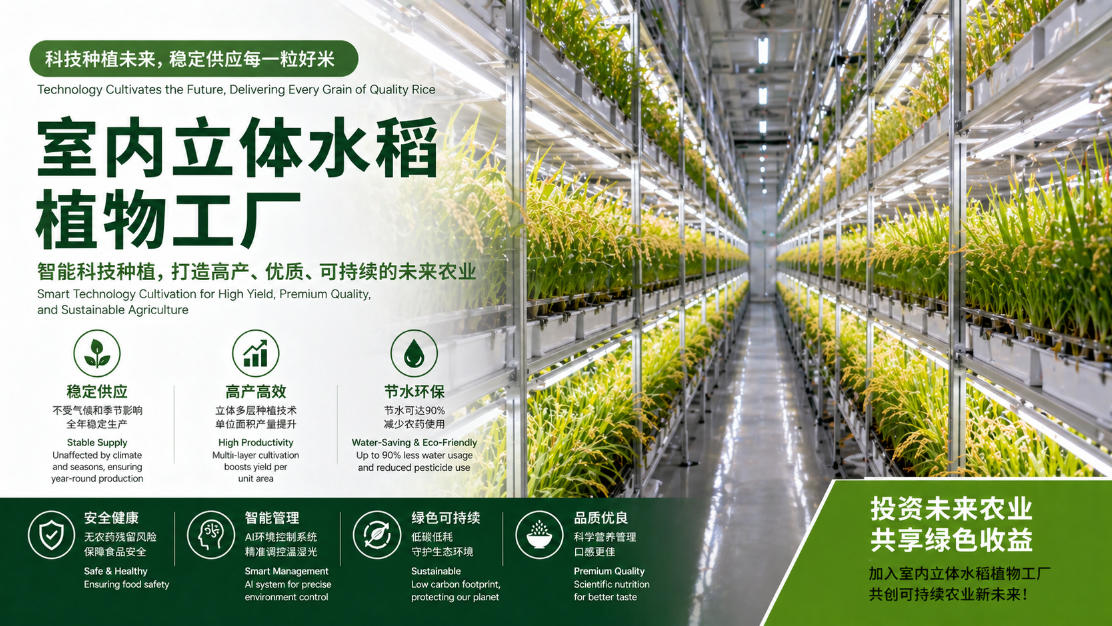
From "Extensive Cultivation" to "Molecular-Level Precision Control"
The core competitive edge in future agriculture will lie in data and algorithms.
Customized Functional Staples: Leveraging the precise environmental controls of indoor factories, we can adjust light spectra and nutrient formulations to mass-produce "functional rice." For instance, we can customize low-glycemic index (Low GI) rice for diabetic patients or fortify rice with micronutrients—such as folic acid and zinc—for specific demographic groups.
Digital Twin Agriculture: Every single rice plant will possess a real-time, synchronized "digital twin" in the virtual space. The LEAFYMAN system will employ AI to forecast daily growth progress and dynamically adjust production schedules based on global energy price fluctuations, thereby maximizing economic efficiency.
Industrialized Breeding: An "Accelerator" for National Food Security
Indoor rice factories will completely shatter the seasonal constraints currently imposed on agricultural research.
Global Breeding Laboratories: Breeding efforts will no longer be geographically restricted to traditional southern breeding bases. Researchers will be able to screen thousands of hybrid combinations right within office buildings. This "industrialized breeding" model will accelerate the pace of variety renewal for Chinese rice strains by 3 to 5 times, ensuring absolute technological leadership in the seed industry.
Biodiversity Banks: Indoor factories can simulate any vanished ancient climatic environment, enabling the restoration or preservation of rare rice germplasm resources and serving as living "seed banks." Cost Smoothing Driven by the Energy Revolution
The most significant barriers hindering the widespread adoption of indoor rice factories are light energy conversion efficiency and energy consumption costs.
A Dual Breakthrough in Photovoltaics and Luminous Efficiency: With the proliferation of next-generation perovskite photovoltaic technology, low-cost, clean energy will serve as the foundational infrastructure for indoor plant factories. Concurrently, the "Dynamic Spectral Response Technology" currently being optimized by LEAFYMAN will push LED energy utilization efficiency ever closer to its theoretical physical limits—thereby endowing the commercial-scale cultivation of staple crops indoors with the potential to compete with traditional open-field agriculture within the next 10 to 15 years.
In future urban planning, indoor rice factories—centered around LEAFYMAN technology—will become a standard component of urban infrastructure, much like power substations or water treatment plants.
Eliminating Logistics Risks: By establishing rice factories within city centers or their immediate suburbs, we can achieve "harvest-on-demand" supply of staple grains. This not only eliminates the high carbon footprint associated with long-distance, cross-border, or inter-provincial transport but also ensures absolute autonomy over the city's core food supply during periods of extreme weather or supply chain crises.
Multidimensional Space Utilization: Future skyscrapers and underground complexes will integrate rice production modules, utilizing urban waste heat and captured carbon dioxide as production inputs to realize an ecological symbiosis between "urban architecture" and "agricultural production."
From "Extensive Cultivation" to "Molecular-Level Precision Control"
The core competitive edge in future agriculture will lie in data and algorithms.
Customized Functional Staples: Leveraging the precise environmental controls of indoor factories, we can adjust light spectra and nutrient formulations to mass-produce "functional rice." For instance, we can customize low-glycemic index (Low GI) rice for diabetic patients or fortify rice with micronutrients—such as folic acid and zinc—for specific demographic groups.
Digital Twin Agriculture: Every single rice plant will possess a real-time, synchronized "digital twin" in the virtual space. The LEAFYMAN system will employ AI to forecast daily growth progress and dynamically adjust production schedules based on global energy price fluctuations, thereby maximizing economic efficiency.
Industrialized Breeding: An "Accelerator" for National Food Security
Indoor rice factories will completely shatter the seasonal constraints currently imposed on agricultural research.
Global Breeding Laboratories: Breeding efforts will no longer be geographically restricted to traditional southern breeding bases. Researchers will be able to screen thousands of hybrid combinations right within office buildings. This "industrialized breeding" model will accelerate the pace of variety renewal for Chinese rice strains by 3 to 5 times, ensuring absolute technological leadership in the seed industry.
Biodiversity Banks: Indoor factories can simulate any vanished ancient climatic environment, enabling the restoration or preservation of rare rice germplasm resources and serving as living "seed banks." Cost Smoothing Driven by the Energy Revolution
The most significant barriers hindering the widespread adoption of indoor rice factories are light energy conversion efficiency and energy consumption costs.
A Dual Breakthrough in Photovoltaics and Luminous Efficiency: With the proliferation of next-generation perovskite photovoltaic technology, low-cost, clean energy will serve as the foundational infrastructure for indoor plant factories. Concurrently, the "Dynamic Spectral Response Technology" currently being optimized by LEAFYMAN will push LED energy utilization efficiency ever closer to its theoretical physical limits—thereby endowing the commercial-scale cultivation of staple crops indoors with the potential to compete with traditional open-field agriculture within the next 10 to 15 years.