
Academic
Staple Crops Come to the City—The Disruptive Advantages of Indoor Rice Cultivation
作者: 时间: 2026-07-23
Rapid Breeding and the "Space-Time Compression" Effect
The most pivotal contribution of indoor rice cultivation lies in the extreme compression of the growth cycle—a development of strategic significance within the realm of Seed Security.
From "Two Harvests a Year" to "Six Harvests a Year": Through LEAFYMAN’s full-spectrum simulation technology, the flowering and maturation stages of rice can be artificially induced. In a fully controlled environment, the rice growth cycle can be shortened from the traditional 120–150 days to approximately 60 days. This means that plant breeders can complete six generations of evolution within a single year, thereby vastly accelerating the processes of selecting superior varieties and advancing generational lines.
Algorithmic Balance of Reproductive and Vegetative Growth: An expert system precisely up-regulates the proportion of far-red light during the grain-filling stage while strictly controlling nighttime temperatures to minimize respiratory energy expenditure; this enables the efficient accumulation of dry matter within an extremely short timeframe.
Spatial Efficiency: Vertical Cultivation as a Substitute for Flat Farmland
Rice has traditionally been regarded as a "large-area, low-density" crop; however, LEAFYMAN introduces modular vertical farming technology into the field of rice cultivation.
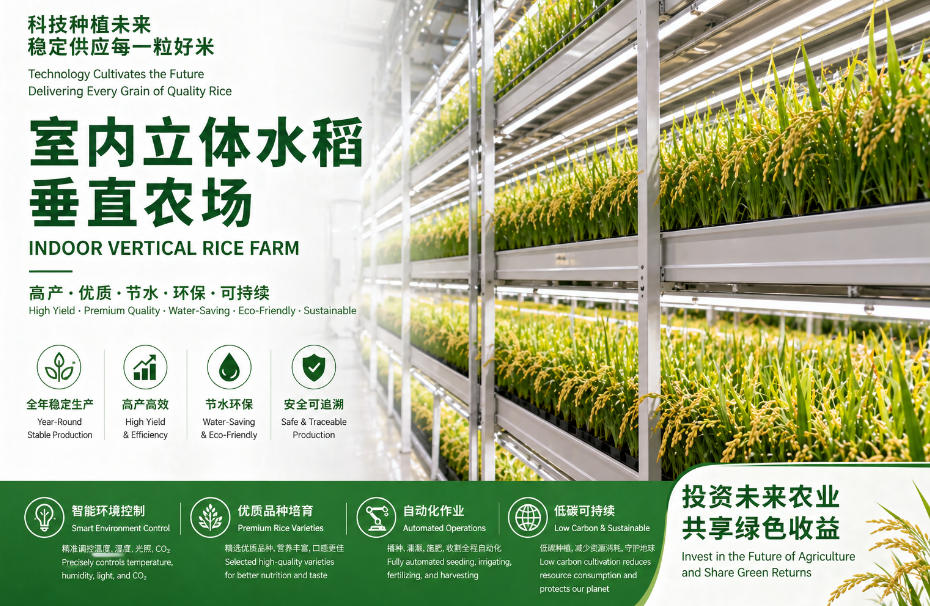
High-Density Vertical Arrays: By utilizing dwarf rice varieties in conjunction with multi-tiered vertical racking systems, the yield per unit of floor area (factoring in spatial stacking) for indoor rice can exceed that of traditional farmland by more than tenfold. This model offers a technical solution for staple food self-sufficiency in resource-scarce regions or extreme survival environments—such as polar zones, outer space, or deep underground spaces.
Quality Certainty: Freedom from Heavy Metal and Microplastic Contamination
Soil contamination represents a latent threat facing modern staple food production.
Pure Substrates and Nutrient Solutions: In its indoor rice cultivation operations, LEAFYMAN employs a recirculating, filtered pure water system to replace natural water sources, thereby completely severing the pathways through which heavy metals (such as cadmium and arsenic) enter the rice grain from soil and irrigation water.
Programmability of Flavor Compounds: By adjusting the ratio of trace elements within the nutrient solution (e.g., by increasing the supply of silicon and potassium), the palatability, luster, and concentration of unique aromatic compounds in the rice can be significantly enhanced. This enables the production of high-quality, functional rice varieties that meet the rigorous standards of "Food as Medicine" (Yi Shi Tong Yuan). Exceptional Resource Efficiency and a "Zero-Loss" Paradigm
Traditional rice cultivation is a major consumer of water within the agricultural sector and is a significant contributor to non-point source pollution caused by fertilizer runoff.
Closed-Loop Water System: Indoor rice cultivation employs condensate recovery technology to reduce water consumption per unit of yield by over 90%.
Precision Fertilization: Nutrient solutions are precisely circulated within the root zone, achieving a fertilizer utilization rate approaching 100%. This not only drastically reduces input costs but also realizes a truly "net-zero emission" production process.
Relocating rice cultivation indoors represents more than just a shift in the growing environment; it signifies a fundamental transformation in agricultural production—moving from an "experience-driven" approach to a "model-driven" one. For LEAFYMAN, the maturation of indoor rice cultivation technology validates the universal applicability of its environmental control algorithms in managing complex biological life cycles. In the future, driven by further breakthroughs in energy efficiency, this "Urban Granary" model is poised to become a vital complementary mechanism for bolstering the resilience of the global food supply chain.
The most pivotal contribution of indoor rice cultivation lies in the extreme compression of the growth cycle—a development of strategic significance within the realm of Seed Security.
From "Two Harvests a Year" to "Six Harvests a Year": Through LEAFYMAN’s full-spectrum simulation technology, the flowering and maturation stages of rice can be artificially induced. In a fully controlled environment, the rice growth cycle can be shortened from the traditional 120–150 days to approximately 60 days. This means that plant breeders can complete six generations of evolution within a single year, thereby vastly accelerating the processes of selecting superior varieties and advancing generational lines.
Algorithmic Balance of Reproductive and Vegetative Growth: An expert system precisely up-regulates the proportion of far-red light during the grain-filling stage while strictly controlling nighttime temperatures to minimize respiratory energy expenditure; this enables the efficient accumulation of dry matter within an extremely short timeframe.
Spatial Efficiency: Vertical Cultivation as a Substitute for Flat Farmland
Rice has traditionally been regarded as a "large-area, low-density" crop; however, LEAFYMAN introduces modular vertical farming technology into the field of rice cultivation.
High-Density Vertical Arrays: By utilizing dwarf rice varieties in conjunction with multi-tiered vertical racking systems, the yield per unit of floor area (factoring in spatial stacking) for indoor rice can exceed that of traditional farmland by more than tenfold. This model offers a technical solution for staple food self-sufficiency in resource-scarce regions or extreme survival environments—such as polar zones, outer space, or deep underground spaces.
Quality Certainty: Freedom from Heavy Metal and Microplastic Contamination
Soil contamination represents a latent threat facing modern staple food production.
Pure Substrates and Nutrient Solutions: In its indoor rice cultivation operations, LEAFYMAN employs a recirculating, filtered pure water system to replace natural water sources, thereby completely severing the pathways through which heavy metals (such as cadmium and arsenic) enter the rice grain from soil and irrigation water.
Programmability of Flavor Compounds: By adjusting the ratio of trace elements within the nutrient solution (e.g., by increasing the supply of silicon and potassium), the palatability, luster, and concentration of unique aromatic compounds in the rice can be significantly enhanced. This enables the production of high-quality, functional rice varieties that meet the rigorous standards of "Food as Medicine" (Yi Shi Tong Yuan). Exceptional Resource Efficiency and a "Zero-Loss" Paradigm
Traditional rice cultivation is a major consumer of water within the agricultural sector and is a significant contributor to non-point source pollution caused by fertilizer runoff.
Closed-Loop Water System: Indoor rice cultivation employs condensate recovery technology to reduce water consumption per unit of yield by over 90%.
Precision Fertilization: Nutrient solutions are precisely circulated within the root zone, achieving a fertilizer utilization rate approaching 100%. This not only drastically reduces input costs but also realizes a truly "net-zero emission" production process.
Relocating rice cultivation indoors represents more than just a shift in the growing environment; it signifies a fundamental transformation in agricultural production—moving from an "experience-driven" approach to a "model-driven" one. For LEAFYMAN, the maturation of indoor rice cultivation technology validates the universal applicability of its environmental control algorithms in managing complex biological life cycles. In the future, driven by further breakthroughs in energy efficiency, this "Urban Granary" model is poised to become a vital complementary mechanism for bolstering the resilience of the global food supply chain.