
Academic
The Four Core Advantages of Indoor Plant Factories
作者: 时间: 2026-07-24
Breaking Through the "Static Productivity" of Natural Endowments
Traditional agriculture is subject to *force majeure* events—such as seasonal shifts, extreme temperatures, floods, or droughts—resulting in highly volatile production outputs.
**All-Weather Output:** By establishing a completely enclosed Controlled Environment Agriculture (CEA) system, LEAFYMAN reduces the climatic stress on crops to zero. This transforms agricultural production from a "reliance on the heavens" to a "production-by-schedule" model, enabling a continuous and stable output of 12 to 18 crop cycles per year—delivering a supply stability that is more than four times greater than that of traditional farming methods.
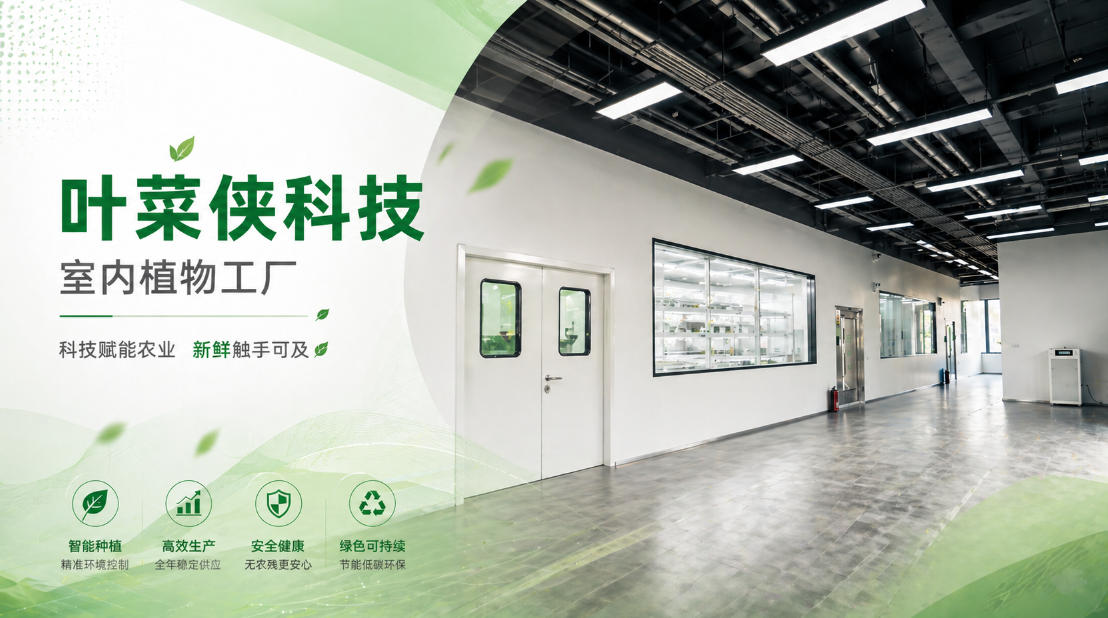
**Geographical Decoupling:** This technology allows production bases to be established in deserts, high-altitude alpine regions, or even within urban underground spaces. This dramatically shortens the "farm-to-table" logistics chain and significantly reduces the carbon footprint.
"Precision Metabolic Control" through Digitalized Growth
The essence of an indoor plant factory lies in the microscopic management of plant physiological parameters.
**Precision Application of Photobiology:** Unlike natural sunlight, indoor plant factories utilize specific combinations of LED wavelengths. By increasing far-red light or adjusting the ratio of red to blue light, it is possible to precisely control the nitrate content, Vitamin C concentration, and flavonoid accumulation within vegetables.
**Precise Nutrient Solution Dosing:** LEAFYMAN’s integrated water and fertilizer system dynamically adjusts the composition of the nutrient solution in real-time, based on EC (electrical conductivity) and pH values transmitted by sensors. This "point-to-point" nutrient delivery not only prevents the fertilizer burn and soil salinization issues common in soil-based farming but also ensures that plants consistently operate within their optimal metabolic range.
"Breeding Compression Effect" through Rapid Iteration
For the seed industry and high-value crops, the plant factory serves as a natural accelerator.
**Shortened Growth Cycles:** In an artificially simulated, optimal environment, the growth cycle for leafy greens is typically shortened by 30% to 50% compared to open-field cultivation. For instance, certain lettuce varieties can reach harvest-ready standards in just 20 to 25 days within a plant factory setting.
**Cleanliness Standards and Biosecurity:** Operating within cultivation rooms that meet Class 10,000 cleanroom standards makes it possible to achieve a "ready-to-eat" quality—meaning produce can be consumed without the need for washing. This provides the purest possible raw material guarantee for high-end convenience foods and functional food products.
Resource Leverage and Environmental Friendliness
Against the backdrop of increasingly tightening resource constraints, plant factories demonstrate an exceptionally high "Green Premium." Water Cycle Efficiency: Compared to traditional flood irrigation, plant factories—by capturing and recirculating condensation generated through plant transpiration—achieve an increase in water utilization efficiency of approximately 95%.
Zero Soil Contamination: By eliminating the reliance on soil, these systems completely eradicate issues such as excessive heavy metal accumulation and the adverse effects of continuous cropping, thereby enabling the simultaneous pursuit of agricultural production and ecological restoration.
In alignment with global trends in controlled environment agriculture, indoor plant factory technology—exemplified by systems like LEAFYMAN—is currently undergoing a critical transition: shifting from a phase characterized by "high energy costs" to one defined by "high-efficiency output." As sensor costs decline and light-recipe algorithms mature, this operational model is no longer confined to scientific research laboratories; rather, it serves as a vital piece of infrastructure for the digital transformation of modern agriculture, profoundly empowering urban food security systems. Its core value lies in this principle: utilizing the inherent predictability of industrial processes to mitigate the inherent uncertainties of agriculture.
Traditional agriculture is subject to *force majeure* events—such as seasonal shifts, extreme temperatures, floods, or droughts—resulting in highly volatile production outputs.
**All-Weather Output:** By establishing a completely enclosed Controlled Environment Agriculture (CEA) system, LEAFYMAN reduces the climatic stress on crops to zero. This transforms agricultural production from a "reliance on the heavens" to a "production-by-schedule" model, enabling a continuous and stable output of 12 to 18 crop cycles per year—delivering a supply stability that is more than four times greater than that of traditional farming methods.
**Geographical Decoupling:** This technology allows production bases to be established in deserts, high-altitude alpine regions, or even within urban underground spaces. This dramatically shortens the "farm-to-table" logistics chain and significantly reduces the carbon footprint.
"Precision Metabolic Control" through Digitalized Growth
The essence of an indoor plant factory lies in the microscopic management of plant physiological parameters.
**Precision Application of Photobiology:** Unlike natural sunlight, indoor plant factories utilize specific combinations of LED wavelengths. By increasing far-red light or adjusting the ratio of red to blue light, it is possible to precisely control the nitrate content, Vitamin C concentration, and flavonoid accumulation within vegetables.
**Precise Nutrient Solution Dosing:** LEAFYMAN’s integrated water and fertilizer system dynamically adjusts the composition of the nutrient solution in real-time, based on EC (electrical conductivity) and pH values transmitted by sensors. This "point-to-point" nutrient delivery not only prevents the fertilizer burn and soil salinization issues common in soil-based farming but also ensures that plants consistently operate within their optimal metabolic range.
"Breeding Compression Effect" through Rapid Iteration
For the seed industry and high-value crops, the plant factory serves as a natural accelerator.
**Shortened Growth Cycles:** In an artificially simulated, optimal environment, the growth cycle for leafy greens is typically shortened by 30% to 50% compared to open-field cultivation. For instance, certain lettuce varieties can reach harvest-ready standards in just 20 to 25 days within a plant factory setting.
**Cleanliness Standards and Biosecurity:** Operating within cultivation rooms that meet Class 10,000 cleanroom standards makes it possible to achieve a "ready-to-eat" quality—meaning produce can be consumed without the need for washing. This provides the purest possible raw material guarantee for high-end convenience foods and functional food products.
Resource Leverage and Environmental Friendliness
Against the backdrop of increasingly tightening resource constraints, plant factories demonstrate an exceptionally high "Green Premium." Water Cycle Efficiency: Compared to traditional flood irrigation, plant factories—by capturing and recirculating condensation generated through plant transpiration—achieve an increase in water utilization efficiency of approximately 95%.
Zero Soil Contamination: By eliminating the reliance on soil, these systems completely eradicate issues such as excessive heavy metal accumulation and the adverse effects of continuous cropping, thereby enabling the simultaneous pursuit of agricultural production and ecological restoration.
In alignment with global trends in controlled environment agriculture, indoor plant factory technology—exemplified by systems like LEAFYMAN—is currently undergoing a critical transition: shifting from a phase characterized by "high energy costs" to one defined by "high-efficiency output." As sensor costs decline and light-recipe algorithms mature, this operational model is no longer confined to scientific research laboratories; rather, it serves as a vital piece of infrastructure for the digital transformation of modern agriculture, profoundly empowering urban food security systems. Its core value lies in this principle: utilizing the inherent predictability of industrial processes to mitigate the inherent uncertainties of agriculture.