
Academic
Global Strategic Alignment and 2026 Industry Outlook
作者: 时间: 2026-04-17
The trajectory of vertical farming in 2026 has moved beyond the "proof of concept" phase into a period of Deep Infrastructure Integration. As global Controlled Environment Agriculture (CEA) market valuation approaches $70 billion USD, the focus for industry leaders like LEAFYMAN has shifted toward maximizing the "Marginal Utility of Automation."
Data-Driven Operational Standards
Current 2026 performance benchmarks indicate that top-tier vertical farms are now achieving a 95% reduction in water consumption compared to open-field farming. However, the true differentiator in this fiscal year is the AI-Climate Pairing Strategy. By integrating adaptive LED lighting with AI-driven environmental response systems, operational energy consumption is being reduced by an additional 15% to 30%.
For a specialized leafy green production chain, this data translates into a "Compressive Harvest Cycle." For instance, high-tech facilities are now reporting:
Reduced Days-to-Harvest: Accelerated growth cycles for key varieties (e.g., lettuce and kale) through precision spectral tuning.
Predictive Yield Accuracy: AI-powered plant tracking that ensures consistent biomass output, critical for B2B contract fulfillment with supermarkets and pharmaceutical partners.
Zero-Pesticide Certification: Utilizing automated machinery and sterile environment protocols to meet the rising global demand for organic, pollution-free urban produce.
Future-Proofing the Agricultural Industrial Chain
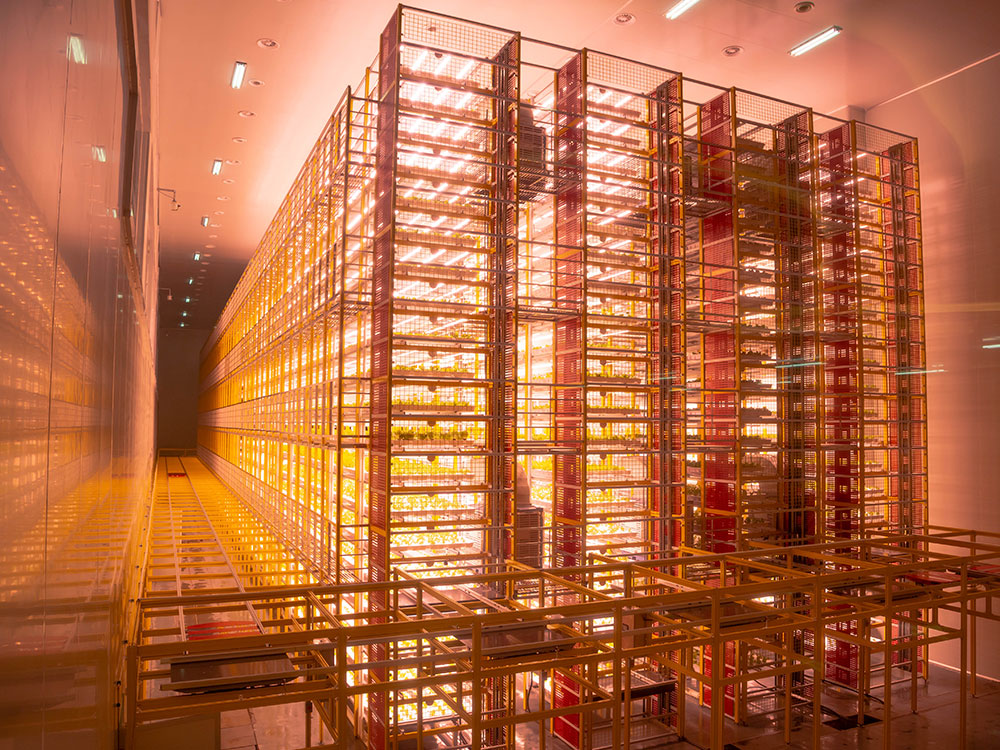
Looking toward 2027 and beyond, the scalability of the "Leafy Green Industrial Chain" depends on Modular Infrastructure. The market is trending toward high-density grow rack systems that push the boundaries of vertical clearance (often exceeding 10 meters) while maintaining lighting uniformity across all tiers.
Enterprises that maintain a "Lean Operation" underpinned by automation—such as LEAFYMAN’s use of fluid engineering and intelligent equipment—are better positioned to access emerging Green Financing and Agritech Insurance frameworks. As urbanization continues to constrain arable land, the ability to deploy "Plug-and-Play" plant factory modules near consumption hubs is not just a technological feat; it is the cornerstone of a resilient, modern food security strategy.
#VerticalFarming2026 #AgTechInnovation #SmartAgriculture #SustainableSupplyChain #HydroponicExpertise
Data-Driven Operational Standards
Current 2026 performance benchmarks indicate that top-tier vertical farms are now achieving a 95% reduction in water consumption compared to open-field farming. However, the true differentiator in this fiscal year is the AI-Climate Pairing Strategy. By integrating adaptive LED lighting with AI-driven environmental response systems, operational energy consumption is being reduced by an additional 15% to 30%.
For a specialized leafy green production chain, this data translates into a "Compressive Harvest Cycle." For instance, high-tech facilities are now reporting:
Reduced Days-to-Harvest: Accelerated growth cycles for key varieties (e.g., lettuce and kale) through precision spectral tuning.
Predictive Yield Accuracy: AI-powered plant tracking that ensures consistent biomass output, critical for B2B contract fulfillment with supermarkets and pharmaceutical partners.
Zero-Pesticide Certification: Utilizing automated machinery and sterile environment protocols to meet the rising global demand for organic, pollution-free urban produce.
Future-Proofing the Agricultural Industrial Chain
Looking toward 2027 and beyond, the scalability of the "Leafy Green Industrial Chain" depends on Modular Infrastructure. The market is trending toward high-density grow rack systems that push the boundaries of vertical clearance (often exceeding 10 meters) while maintaining lighting uniformity across all tiers.
Enterprises that maintain a "Lean Operation" underpinned by automation—such as LEAFYMAN’s use of fluid engineering and intelligent equipment—are better positioned to access emerging Green Financing and Agritech Insurance frameworks. As urbanization continues to constrain arable land, the ability to deploy "Plug-and-Play" plant factory modules near consumption hubs is not just a technological feat; it is the cornerstone of a resilient, modern food security strategy.
#VerticalFarming2026 #AgTechInnovation #SmartAgriculture #SustainableSupplyChain #HydroponicExpertise