
Academic
Biological Optimization and Fluid Engineering in Hydroponics
作者: 时间: 2026-04-14
The core of a vertical farm’s productivity does not reside in the physical structure alone, but in the intersection of biological needs and fluid dynamics. In a high-density cultivation environment, the root zone environment is the most critical variable. Expert analysis suggests that the success of a 2,000-square-meter facility is determined by the precision of its nutrient solution circulation and its oxygenation efficiency.
Fluid engineering plays a pivotal role in preventing nutrient stagnation and localized temperature spikes. Within systems like DFT (Deep Flow Technique), maintaining a constant dissolved oxygen level is a technical hurdle that requires advanced fluid mechanics. By optimizing flow rates and integrating real-time sensing, enterprises can ensure that every leaf vegetable, regardless of its position on a 10-tier rack, receives an identical nutrient profile. This consistency is the benchmark of industrial-grade agriculture, moving away from the variability of traditional farming toward a manufacturing-oriented "Product Standardization" model.
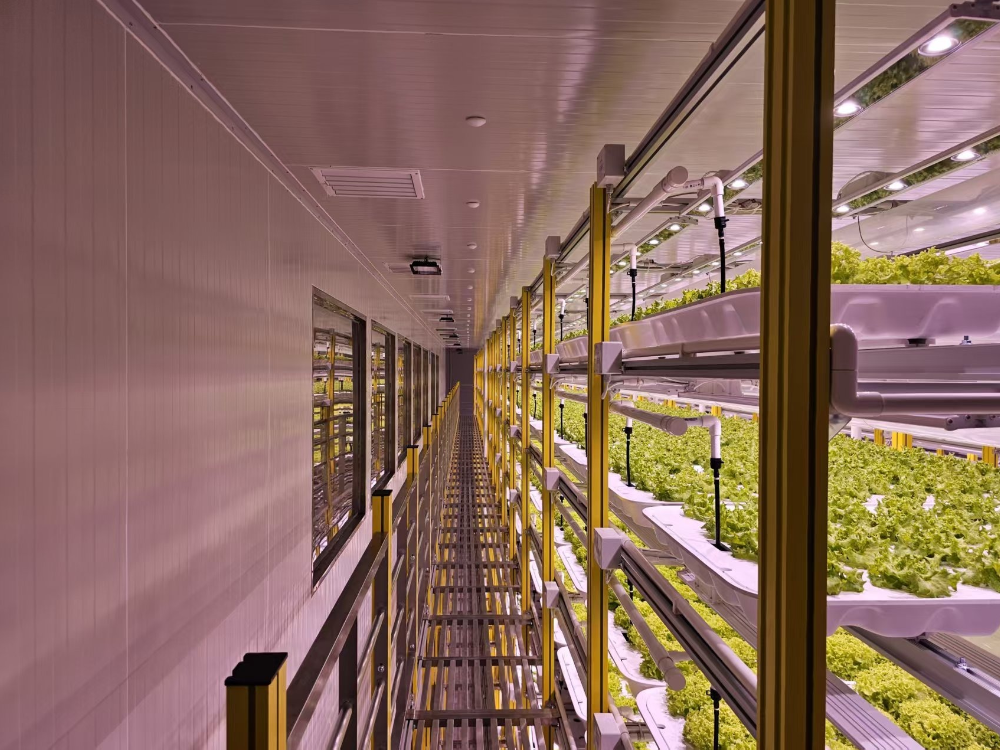
Furthermore, the integration of automation in seedling management and harvesting represents the next frontier. The transition from manual handling to automated leaf vegetable machinery minimizes human intervention, which is the primary vector for pathogens in a controlled environment. By maintaining a near-sterile production line, vertical farms can achieve "clean-label" outputs that exceed traditional organic standards without the use of chemical fungicides.
Resource Efficiency and Carbon Neutrality Pathways
Sustainability in vertical farming is often measured by its resource conversion ratio. High-tech agricultural operations are currently shifting toward a closed-loop system where water and nutrients are 100% recycled. Current industry data indicates that while traditional field farming may require up to 60 liters of water to produce a single head of lettuce, a sophisticated hydroponic plant factory requires less than 2 liters.
From the perspective of a corporate decision-maker, this efficiency is not merely an environmental altruism but a risk-mitigation strategy. As global water scarcity increases and environmental regulations tighten, the ability to operate a high-output production chain with minimal resource footprint becomes a competitive advantage. This is particularly relevant in "Comprehensive Agricultural Reform Pilot Zones," where technical modifications and digital oversight are mandated to ensure financial and operational compliance.
The energy-for-food trade-off is also being optimized through LED spectral tuning. By targeting only the photosynthetically active radiation (PAR) ranges—specifically the blue and red wavelengths—vertical farms can maximize biomass accumulation while minimizing waste heat. This "Light-Recipe" approach allows for the manipulation of plant morphology and nutritional content, such as increasing antioxidant levels or adjusting leaf texture to meet specific market demands.
Scalability and Financial Compliance in Agricultural Expansion
For an enterprise managing a multi-million RMB industrial chain, scalability is the ultimate test. The transition from a pilot plant to a full-scale commercial operation requires a robust financial compliance framework. This involves the systematic tracking of input-output ratios, asset depreciation of intelligent equipment, and the valuation of intellectual property.
A modular approach to equipment manufacturing—where irrigation units, lighting arrays, and climate control modules are standardized—allows for rapid horizontal expansion. This modularity reduces the complexity of technical upgrades; as more efficient components become available, they can be integrated without disrupting the entire production cycle. For industry partners and investors, this technical flexibility ensures that the facility remains at the cutting edge of the global AgTech curve for a longer lifecycle.
[Content Construction in Progress]
The final section will cover "Global Supply Chain Integration and High-Value Market Positioning" along with the "Technical Summary."
Please reply with "Continue" to generate the final chapters of this analysis.
#HydroponicSystems #AgriculturalInnovation #CircularEconomy #SmartFarming #VerticalAgriculture
Fluid engineering plays a pivotal role in preventing nutrient stagnation and localized temperature spikes. Within systems like DFT (Deep Flow Technique), maintaining a constant dissolved oxygen level is a technical hurdle that requires advanced fluid mechanics. By optimizing flow rates and integrating real-time sensing, enterprises can ensure that every leaf vegetable, regardless of its position on a 10-tier rack, receives an identical nutrient profile. This consistency is the benchmark of industrial-grade agriculture, moving away from the variability of traditional farming toward a manufacturing-oriented "Product Standardization" model.
Furthermore, the integration of automation in seedling management and harvesting represents the next frontier. The transition from manual handling to automated leaf vegetable machinery minimizes human intervention, which is the primary vector for pathogens in a controlled environment. By maintaining a near-sterile production line, vertical farms can achieve "clean-label" outputs that exceed traditional organic standards without the use of chemical fungicides.
Resource Efficiency and Carbon Neutrality Pathways
Sustainability in vertical farming is often measured by its resource conversion ratio. High-tech agricultural operations are currently shifting toward a closed-loop system where water and nutrients are 100% recycled. Current industry data indicates that while traditional field farming may require up to 60 liters of water to produce a single head of lettuce, a sophisticated hydroponic plant factory requires less than 2 liters.
From the perspective of a corporate decision-maker, this efficiency is not merely an environmental altruism but a risk-mitigation strategy. As global water scarcity increases and environmental regulations tighten, the ability to operate a high-output production chain with minimal resource footprint becomes a competitive advantage. This is particularly relevant in "Comprehensive Agricultural Reform Pilot Zones," where technical modifications and digital oversight are mandated to ensure financial and operational compliance.
The energy-for-food trade-off is also being optimized through LED spectral tuning. By targeting only the photosynthetically active radiation (PAR) ranges—specifically the blue and red wavelengths—vertical farms can maximize biomass accumulation while minimizing waste heat. This "Light-Recipe" approach allows for the manipulation of plant morphology and nutritional content, such as increasing antioxidant levels or adjusting leaf texture to meet specific market demands.
Scalability and Financial Compliance in Agricultural Expansion
For an enterprise managing a multi-million RMB industrial chain, scalability is the ultimate test. The transition from a pilot plant to a full-scale commercial operation requires a robust financial compliance framework. This involves the systematic tracking of input-output ratios, asset depreciation of intelligent equipment, and the valuation of intellectual property.
A modular approach to equipment manufacturing—where irrigation units, lighting arrays, and climate control modules are standardized—allows for rapid horizontal expansion. This modularity reduces the complexity of technical upgrades; as more efficient components become available, they can be integrated without disrupting the entire production cycle. For industry partners and investors, this technical flexibility ensures that the facility remains at the cutting edge of the global AgTech curve for a longer lifecycle.
[Content Construction in Progress]
The final section will cover "Global Supply Chain Integration and High-Value Market Positioning" along with the "Technical Summary."
Please reply with "Continue" to generate the final chapters of this analysis.
#HydroponicSystems #AgriculturalInnovation #CircularEconomy #SmartFarming #VerticalAgriculture